
WaybackWire

The news as it happened.

The Ides of March20 March 44 BCIssue the Seventh

Caesar burned in the Forum, and the crowd turns on his killers

Reconstructed from historical sources

Caesar’s will, adopting Octavius and leaving every citizen 300 sesterces, has the people longing for him as Antony reads his honours over the body and lifts his bloodied robe; they burn him in the Forum on a pyre of their own making, go with fire to the houses of Brutus and Cassius, and kill Helvius Cinna in mistake for the praetor.

ROME, three days after the Liberalia.—Caesar’s body is burning tonight in the Forum on a pyre the people built with their own hands, and the mourning crowd has carried fire to the houses of the men who killed him.

The people came to the funeral already moved to kindness and longing for Caesar by his gifts to them. Then a line from a play of Pacuvius was sung as though in the dead man’s own voice: “Saved I these men that they might murder me?” It roused pity and anger together. Some in the crowd cried out to kill the murderers.

Antony, the consul, spoke over the body, reading out the honours voted to Caesar and the oaths sworn to guard him.

Saved I these men that they might murder me?Sung at Caesar's funeral as in his own voice, a line from a play of Pacuvius

The body had been meant for the pyre made ready on the Campus Martius, near the tomb of Julia. It never reached it. The people heaped benches, railings and tables from the Forum about the bier, and two armed men set the pile alight. The fire burns on into the night.

Then the crowd turned on the killers. Men took burning brands from the pyre and ran with them to the houses of Brutus and Cassius. Servants and neighbours drove them off, though not easily.

The men who struck Caesar are behind barricaded doors. Others in the crowd have gone about the city searching for them.

Those turned back from the houses left a threat behind them: they will come again tomorrow, and come armed.

Suetonius, Divus Julius (Loeb, tr. Rolfe, 1914) · Plutarch, Life of Brutus (Loeb, tr. Perrin, 1918) · Plutarch, Life of Caesar (Loeb, tr. Perrin, 1919) · Appian, Civil Wars book 2 (tr. Horace White, 1899) · Plutarch, Life of Brutus (Loeb, tr. Perrin, 1918).
Caesar’s will adopts Octavius and names men who struck him

Reconstructed from historical sources

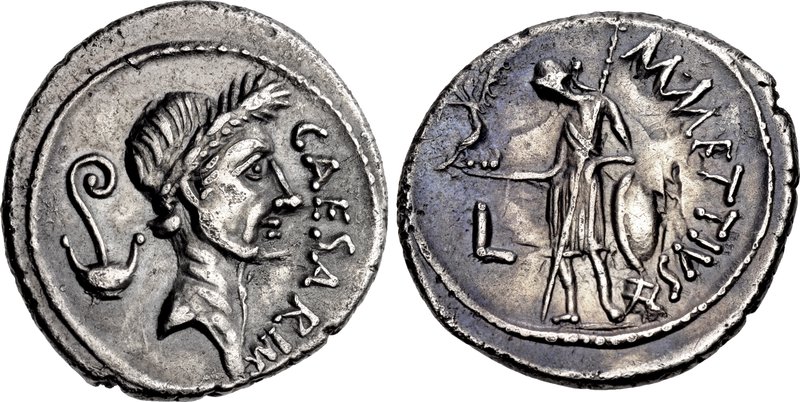
A silver denarius struck at Rome this winter: Caesar's wreathed head with the words CAESAR IMP; on the other face, Venus holding a small Victory.
A silver denarius struck at Rome this winter: Caesar’s wreathed head with the words CAESAR IMP; on the other face, Venus holding a small Victory.Photograph by Classical Numismatic Group (cngcoins.com), via Wikimedia Commons, Feb. 28, 44 BC · CC BY-SA 2.5

ROME, three days after the Liberalia.—Caesar has adopted Octavius, the grandson of his sister, as his son and left him three-quarters of his estate, by the terms of his will, read yesterday.

Pinarius and Pedius, also grandsons of Caesar’s sisters, share the remaining quarter.

Every citizen is left 300 sesterces, and the people are given Caesar’s gardens across the Tiber as a place of recreation.

The will was opened and read at the house of Antony, the consul, at the request of Lucius Piso, Caesar’s father-in-law, as the Senate had ordered. Caesar drew it up last September and lodged it with the chief of the Vestal Virgins.

Several of the men who killed Caesar are named in it as guardians of a son, should one be born to him. Decimus Brutus, one of the men who struck him, stands among the heirs in the second degree.

The people were moved to pity that a man Caesar had named among his heirs was one of his killers.

Suetonius, Divus Julius (Loeb, tr. Rolfe, 1914) · Suetonius, Life of Julius Caesar (Loeb, tr. Rolfe, 1914) · Appian, Civil Wars book 2 (tr. Horace White, 1899) · Appian, Civil Wars book 2 (tr. Horace White, 1899).

Antony reads Caesar’s honours and the oaths over the body

Reconstructed from historical sources

ROME, three days after the Liberalia.—Antony, the consul, stood over Caesar’s body in the Forum today and read out the decrees by which the Senate and people had voted him honours, divine as well as human, turning to the body at each one.

Lucius Piso had brought the body into the Forum, where it was laid in the gilded shrine on the Rostra, made in the likeness of the temple of Venus Genetrix, and a large armed crowd gathered to guard it.

When he had recited the oaths by which all were bound to guard Caesar, Antony raised his voice and stretched out his hand towards the Capitol. “Jupiter, guardian of this city, and ye other gods, I stand ready to avenge him as I have sworn and vowed, but since those who are of equal rank with me have considered the decree of amnesty beneficial, I pray that it may prove so.” A stir went through the senators present.

Jupiter, guardian of this city, and ye other gods, I stand ready to avenge him as I have sworn and vowed, but since those who are of equal rank with me have considered the decree of amnesty beneficial, I pray that it may prove soAntony, the consul, in his funeral speech over Caesar's body

Of the deed itself he said: “It seems to me, fellow-citizens, that this deed is not the work of human beings, but of some evil spirit.”

He closed with a call to mourn: “Let us then conduct this sacred one to the abode of the blest, chanting our accustomed hymn of lamentation for him.”

Then he lifted Caesar’s bloodied robe on a spear, and the crowd broke into lamentation. A wax image of Caesar, showing his wounds, was turned about for all to see, and the people could bear the sight no longer.

Many in the crowd have begun to regret the amnesty.

Appian, Civil Wars book 2 (tr. Horace White, 1899) · Appian, Civil Wars book 2 (tr. Horace White, 1899) · Appian, Civil Wars book 2 (tr. Horace White, 1899) · Plutarch, Life of Caesar (Loeb, tr. Perrin, 1919) · Suetonius, Divus Julius (Loeb, tr. Rolfe, 1914).

Caesar’s friend Helvius Cinna killed by the crowd for his name

Reconstructed from historical sources

ROME, three days after the Liberalia.—Helvius Cinna, a poet and a friend of Caesar, was killed by the crowd today, taken for the praetor Cornelius Cinna.

He had no part in the deed against Caesar, and came to the Forum to do honour to the body.

Those who heard his name took him for the praetor, who had called Caesar a tyrant in the Forum. They fell on him, killed him, and carried his head about on a spear.

The mob, grown violent, was out hunting the men who struck Caesar.

Suetonius, Divus Julius (Loeb, tr. Rolfe, 1914) · Plutarch, Life of Caesar (Loeb, tr. Perrin, 1919) · Suetonius, Divus Julius (Loeb, tr. Rolfe, 1914) · Cassius Dio, Roman History book 44 (Loeb, 1916) · Appian, Civil Wars book 2 (tr. Horace White, 1899).

Robes, arms and jewels thrown on Caesar’s pyre

Reconstructed from historical sources

ROME, three days after the Liberalia.—So great a crowd was expected that mourners had been told they might bring their offerings by whatever street they chose. Musicians and actors tore off their triumphal robes and threw them into the flames. Veterans of Caesar’s legions threw in their arms.

Women gave up their jewels, and their children’s amulets.

Strangers in the city went about lamenting, each after the fashion of his own country. The Jews above all have come to the pyre, and are gathered beside it tonight.

Suetonius, Divus Julius (Loeb, tr. Rolfe, 1914) · Suetonius, Divus Julius (Loeb, tr. Rolfe, 1914).

Priests bar the body from the Capitol

ROME.—Before the burning, part of the crowd tried to carry Caesar’s body up to the Capitol, to bury it there among the gods. The priests would not allow it, and the people turned back down into the Forum.

Appian, Civil Wars book 2 (tr. Horace White, 1899).

Soldiers keep the flames from the buildings

ROME.—Soldiers stood by the pyre in the Forum tonight and kept the crowd from setting fire to the buildings round about, while the body burned.

Cassius Dio, Roman History book 44 (Loeb, 1916).

Start The Ides of March from issue one tomorrow

Wayback Wire · No. 7 · 20 March 44 BC