
WaybackWire

The news as it happened.

The Mongols at BaghdadThe week to Wednesday, February 13, 1258Issue the Fourth

Mongol army goes into Baghdad, killing, burning and plundering

Reconstructed from historical sources

The caliph has come out to the Khan and is held under guard outside the walls, Sulaymanshah and the Dawatdar are dead, and today the Mongol army went into Baghdad, killing, burning and plundering.

Mongol horsemen ride up to a walled city whose defenders sound horns from the towers: a painting in a 14th-century French manuscript. Bibliothèque nationale de France, NAF 886, folio 22.
Mongol horsemen ride up to a walled city whose defenders sound horns from the towers: a painting in a 14th-century French manuscript. Bibliothèque nationale de France, NAF 886, folio 22.Photograph by Unknown painter; Bibliothèque nationale de France · Public domain

BAGHDAD, Wednesday.—With the caliph a prisoner in the Mongol camp and his two great commanders dead, Hülegü Khan’s army went into Baghdad today, Wednesday, the seventh of Safar.

The plunder and the general killing have begun. The army went into the city in one sweep, setting fire as it went, and has burned everything but a few houses.

The Mongols drew their swords on the people of Baghdad and have killed tens of thousands of men. The people have fled where they can, into their houses and down into the sardabs, the underground rooms of the city.

Hülegü has ordered all his soldiers to take the goods and property of Baghdad. The troops are loading themselves with gold and silver, precious stones, pearls and costly garments.

Tonight the killing and the burning go on in the streets of Baghdad.

Rashid al-Din, Jami' al-tawarikh (tr. W. M. Thackston, Harvard, 1998) · Bar Hebraeus, Chronography (tr. E. A. Wallis Budge, London, 1932) · Kirakos Gandzakets'i, History of the Armenians (tr. Robert Bedrosian, New York, 1986).

Caliph comes out to the Khan with his sons and notables

Reconstructed from historical sources

The caliph al-Musta'sim brought before Hülegü Khan: a painting in a Persian manuscript copied in 1398. British Library, Or 2780, folio 89v.
The caliph al-Musta’sim brought before Hülegü Khan: a painting in a Persian manuscript copied in 1398. British Library, Or 2780, folio 89v.Photograph by Unknown painter; manuscript of the Shahanshahnama of Ahmad Tabrizi · Public domain (PD-Art, PD-old-100)

BEFORE BAGHDAD, Wednesday.—The Commander of the Faithful has given himself up to Hülegü Khan, and is held tonight under Mongol guard outside his own city.

On Sunday, the fourth of Safar, having offered last week to surrender, al-Musta’sim came out to the Khan with his three sons, Abu’l-Fadl Abdul-Rahman, Abu’l-Abbas Ahmad and Abu’l-Manaqib Mubarak. With him came three thousand sayyids, imams, cadis, grandees and dignitaries of Baghdad.

The Khan showed no anger. He asked kindly after the caliph’s health, then gave him an order: “Tell the people of the city to throw down their weapons and come out so that we may make a count.”

Tell the people of the city to throw down their weapons and come out so that we may make a countHülegü Khan, to the caliph

The caliph sent word into the city, and heralds cried it through the streets. The people laid down their arms and came out in droves. The Mongols killed them.

The caliph, his sons and his followers have been made to pitch tents at the Kalwadha Gate, in the camp of Ket Buqa, with Mongols set over them as guards.

Rashid al-Din, Jami' al-tawarikh (tr. W. M. Thackston, Harvard, 1998) · Rashid al-Din, Jami' al-tawarikh (tr. W. M. Thackston, Harvard, 1998) · Rashid al-Din, Jami' al-tawarikh (tr. W. M. Thackston, Harvard, 1998).

Baghdad’s army follows its commanders out and is killed

Reconstructed from historical sources

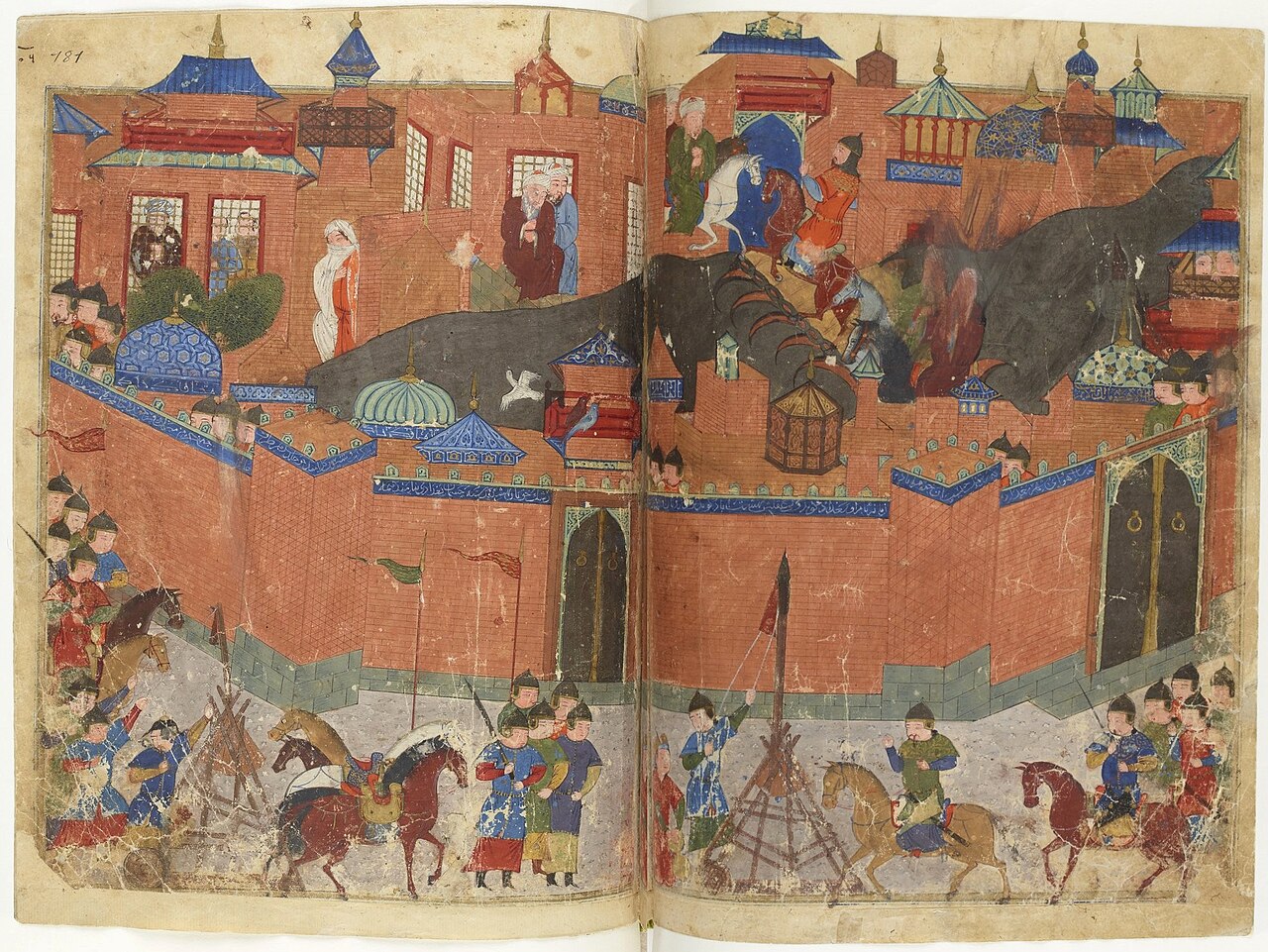
Mongol troops before the walls of Baghdad: a Persian painting made at Herat about 1430. Bibliothèque nationale de France, Supplément persan 1113, folios 180v-181.
Mongol troops before the walls of Baghdad: a Persian painting made at Herat about 1430. Bibliothèque nationale de France, Supplément persan 1113, folios 180v-181.Photograph by Sayf al-Vahidi and others (Herat) · Public domain

BAGHDAD, Wednesday.—The army of Baghdad followed its commanders out of the city, hoping for safety under Hülegü Khan’s word, and has been killed to the last.

On Thursday, the first of Safar, the Khan sent Ibn al-Jawzi into the city, with Fakhr al-Din Damghani and Ibn Durnus, who had come out to him for the caliph a few days before. They carried a decree and a paiza, a tablet of his authority, to bring out Sulaymanshah and the Dawatdar.

The Khan’s message went with them: “The caliph can do what he wants. If he wants, let him come out; if not, let him not come out. But the Mongol troops will remain on the walls where they are until they come out.”

The caliph can do what he wants. If he wants, let him come out; if not, let him not come out. But the Mongol troops will remain on the walls where they are until they come outHülegü Khan, in his message sent into Baghdad

Both commanders came out the same day. They were sent back in to bring out their retainers, for an expedition, they were told, to Egypt and Syria. The army of Baghdad and a great crowd came out with them, hoping for safety.

At the gates people climbed over one another to reach the Khan first. They were divided into units of thousands, hundreds and tens, led far from the city, out of sight of the others, and killed to the last.

Those left inside have hidden wherever they can.

Rashid al-Din, Jami' al-tawarikh (tr. W. M. Thackston, Harvard, 1998) · Rashid al-Din, Jami' al-tawarikh (tr. W. M. Thackston, Harvard, 1998) · Kirakos Gandzakets'i, History of the Armenians (tr. Robert Bedrosian, New York, 1986) · Rashid al-Din, Jami' al-tawarikh (tr. W. M. Thackston, Harvard, 1998).

Sulaymanshah and the Dawatdar put to death; heads sent to Mosul

Reconstructed from historical sources

BEFORE BAGHDAD, Wednesday.—The two men who led the caliph’s soldiers are dead. On Friday, the second of Safar, the Dawatdar Mujahid al-Din Aybak, commander of the caliph’s army, was put to death with his followers.

Sulaymanshah, a commander of the caliph’s troops, was brought before Hülegü the same day with seven hundred of his relatives, their hands bound, and questioned.

“The caliph was headstrong and ill-starred,” Sulaymanshah answered. “He did not listen to the advice of his well-wishers.”

The caliph was headstrong and ill-starredSulaymanshah, commander of the caliph's troops, answering Hülegü

He was put to death with all his followers. Amir Hajjuddin, son of the Big Dawatdar, was killed too.

The heads of all three have been sent to Mosul.

Rashid al-Din, Jami' al-tawarikh (tr. W. M. Thackston, Harvard, 1998).

Christians of Baghdad spared in the church of the Third Bazar

Reconstructed from historical sources

Hülegü and his senior wife Doquz Khatun side by side, holding a cross, in a Syriac Bible of the 13th century. British Library, Add. 7170.
Hülegü and his senior wife Doquz Khatun side by side, holding a cross, in a Syriac Bible of the 13th century. British Library, Add. 7170.Photograph by Unknown painter; British Library, Add. 7170 · Public domain

BAGHDAD, Wednesday.—Amid the killing, the Christians of Baghdad have been spared.

The catholicos gathered all the Christians of the city into the church of the Third Bazar and kept them there under his protection. None of them has been hurt.

Doquz Khatun, the Khan’s senior wife and herself a Christian, begged her husband not to kill the Christians of Baghdad, Nestorians and others. Hülegü has spared them, with their goods and property.

The houses of a few Nestorians and some foreigners are the only ones the army has not burned.

Wealthy Arabs brought their riches to the catholicos, hoping to save themselves and their goods. All of them were killed.

Bar Hebraeus, Chronography (tr. E. A. Wallis Budge, London, 1932) · Kirakos Gandzakets'i, History of the Armenians (tr. Robert Bedrosian, New York, 1986) · Rashid al-Din, Jami' al-tawarikh (tr. W. M. Thackston, Harvard, 1998).

Arrow strikes one of the Khan’s great commanders

BEFORE BAGHDAD.—While the crowds were coming out of the city, an arrow struck Hindu Bitigchi, one of Hülegü’s great commanders, in the eye. The Khan has ordered all haste in the taking of Baghdad.

Rashid al-Din, Jami' al-tawarikh (tr. W. M. Thackston, Harvard, 1998).

Tusi posted at the Halaba Gate to grant amnesty

BAGHDAD.—The Khan has posted Nasir al-Din Tusi, his adviser, at the Halaba Gate with power to grant amnesty. People have begun to be brought out of the city there.

Rashid al-Din, Jami' al-tawarikh (tr. W. M. Thackston, Harvard, 1998).

Georgian and Armenian horse make a great slaughter

BAGHDAD.—The Georgian and Armenian horsemen who ride with the Khan have been among the fiercest in the city. The Georgians above all have made a great slaughter, and the cavalry has destroyed without mercy and taken many captives.

Bar Hebraeus, Chronography (tr. E. A. Wallis Budge, London, 1932) · Grigor Aknerts'i, History of the Nation of Archers (tr. Robert Bedrosian).

Start The Mongols at Baghdad from issue one tomorrow

Wayback Wire · No. 4 · The week to Wednesday, February 13, 1258