
WaybackWire

The news as it happened.

Columbus Sails WestSeptember 1492Issue the Second

Land cried from the Pinta proves to be cloud

the Admiral holds west

Reconstructed from historical sources

The land Pinzón cried from the Pinta on 25 September proved to be cloud, but birds and weed tell the Admiral that land is near.

A great ship of the time under full sail off the walled harbour of Modon, from Breydenbach's Pilgrimage to the Holy Land, printed at Lyon in 1488.
A great ship of the time under full sail off the walled harbour of Modon, from Breydenbach’s Pilgrimage to the Holy Land, printed at Lyon in 1488.Photograph by After Erhard Reuwich, for Bernhard von Breydenbach's Pilgrimage to the Holy Land; French edition by Nicolas Le Huen, Lyon, 1488. The Metropolitan Museum of Art, 28.86.2, Dec. 31, 1488 · CC0 (The Metropolitan Museum of Art, via Wikimedia Commons)

AT SEA, WEST OF THE CANARIES, Sunday.—Three weeks out of sight of land, the three ships of Don Cristóbal Colón, Admiral of the Ocean Sea, hold west for the Indies, and the Admiral is sure that land lies close.

“Four boatswain-birds came to the ship, which is a great sign of land,” he writes today, for so many of one kind together are not straying or lost.

He has been deceived once already. On Tuesday 25 September he and Martín Alonso Pinzón, captain of the Pinta, talked across the water over a chart the Admiral had sent to the Pinta three days before, with islands drawn in this sea. Pinzón said the ships were where the islands were placed; the Admiral answered that so it seemed to him, but the currents, which had set the ships to the N.E., might have carried them past.

Four boatswain-birds came to the ship, which is a great sign of landDon Cristóbal Colón, Admiral of the Ocean Sea

At sunset Pinzón went up on the poop of the Pinta and with much joy called across to the Admiral, claiming the reward for sighting land.

The Admiral fell on his knees and gave thanks to God. Pinzón said the Gloria in excelsis with his people, and the flagship’s crew did the same. The men of the Niña climbed the mast and rigging and declared it land.

The Admiral judged it 25 leagues off and turned the fleet from W. to S.W. to make for it.

On Wednesday he held west until the afternoon, then stood S.W. until he made out, he writes, that “what had been said to be land was only clouds”. The fleet is back on its west course, the sea lying like a river and the air pleasant and very mild.

Columbus's Journal of the voyage (Las Casas abstract, tr. Markham, rev. in Olson & Bourne, 1906) · Columbus's Journal of the voyage (Las Casas abstract, tr. Markham, rev. in Olson & Bourne, 1906).
Fleet clears Gomera, warned of Portuguese caravels off Hierro

Reconstructed from historical sources

GOMERA.—The Admiral’s fleet put out from Gomera on the morning of Thursday 6 September, after a caravel from Hierro brought word that three Portuguese caravels lay off that island to take him.

At Gran Canaria the Pinta, after her rudder troubles of August, was repaired very thoroughly by the labour of the Admiral, of Martín Alonso Pinzón and of the rest, and given square sails in place of her lateen rig.

The fleet left Gran Canaria on the afternoon of Saturday 1 September and came to Gomera next day to take in water, wood and meat.

Once out, no wind came. The ships lay becalmed between Gomera and Tenerife until the third hour of Saturday night, when a wind rose from the N.E. and the Admiral shaped his course to the west, the ships taking much sea over the bows.

Columbus's Journal of the voyage (Las Casas abstract, tr. Markham, rev. in Olson & Bourne, 1906) · Columbus's Journal of the voyage (Las Casas abstract, tr. Markham, rev. in Olson & Bourne, 1906) · Churchill's Collection of Voyages and Travels, vol. 2 (London, 3rd ed., 1744): 'The History of the Life and Actions of Admiral Christopher Columbus', by his son Ferdinand Columbus (English translation).

Men weep as land falls astern; the Admiral welcomes a head wind

Reconstructed from historical sources

AT SEA, Sunday.—The Admiral counts a head wind and a rising sea as answers to his men’s fear that no wind in these waters will ever carry them home.

At daybreak on Sunday 9 September, nine leagues west of Hierro, the land passed out of sight. Many men, fearing it would be long before they saw land again, sighed and wept; the Admiral comforted them with great promises of lands and wealth.

He has complained many times, too, that the helmsmen steer badly, letting the ship fall off to the N.E.

This contrary wind was very necessary for me, because my people were much excited at the thought that in these seas no wind ever blew in the direction of SpainDon Cristóbal Colón, Admiral of the Ocean Sea

He welcomed a contrary wind from the W.N.W. on Saturday 22 September. “This contrary wind was very necessary for me, because my people were much excited at the thought that in these seas no wind ever blew in the direction of Spain,” he writes.

Next day, in a smooth sea, the crew began to murmur that there was no great sea, and the wind would never blow to carry them back to Spain. Then the sea rose high without wind, to their astonishment.

The Admiral finds its like only in Scripture. “Thus the high sea was very necessary to me, such as had not appeared but in the time of the Jews when they went out of Egypt and murmured against Moses who delivered them out of captivity,” he writes.

Churchill's Collection of Voyages and Travels, vol. 2 (London, 3rd ed., 1744): 'The History of the Life and Actions of Admiral Christopher Columbus', by his son Ferdinand Columbus (English translation) · Columbus's Journal of the voyage (Las Casas abstract, tr. Markham, rev. in Olson & Bourne, 1906) · Columbus's Journal of the voyage (Las Casas abstract, tr. Markham, rev. in Olson & Bourne, 1906).

Compass needles turn from the north star, alarming the mariners

Reconstructed from historical sources

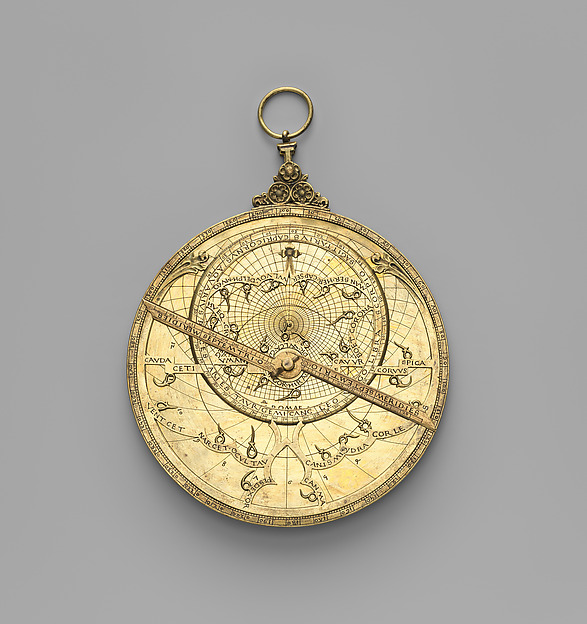
A brass astrolabe made in 1462, an instrument for reading the heights of the stars and telling the time.
A brass astrolabe made in 1462, an instrument for reading the heights of the stars and telling the time.Photograph by Attributed to Regiomontanus (Johannes Müller); photograph: The Metropolitan Museum of Art, The Cloisters Collection, Dec. 31, 1462 · Public domain (Met Open Access, CC0)

AT SEA, Sunday.—The fleet’s compass needles have begun to turn from the north star, to the dismay of the mariners.

It was first seen at nightfall on Thursday 13 September, with the currents against the ships: the needles turned half a point of the compass to the north-west, and somewhat more by morning.

On Monday 17 September the pilots took the north and found the needles a full point west of it. The mariners were alarmed and dejected, and would not say why.

The cause was that the star makes the movement, and not the needlesDon Cristóbal Colón, Admiral of the Ocean Sea

The Admiral had the north taken again at dawn, and the needles were found true. “The cause was that the star makes the movement, and not the needles,” he writes.

He marks it again today: at nightfall the needles vary a point westward and at dawn agree exactly with the star, so the north star seems to move like the others. He has marked, too, how the stars called the Guards move round the pole star.

Columbus's Journal of the voyage (Las Casas abstract, tr. Markham, rev. in Olson & Bourne, 1906).

Birds, weed and a live crab: the Admiral reads the signs of land

Reconstructed from historical sources

A Venetian sea chart signed by Zuane Pizzigano in 1424, showing large islands far out in the western Ocean, the red one named Antilia.
A Venetian sea chart signed by Zuane Pizzigano in 1424, showing large islands far out in the western Ocean, the red one named Antilia.Photograph by Zuane Pizzigano, Venice; James Ford Bell Library, University of Minnesota. Pieced together from the library's images by Wikimedia Commons user XpoferenS, Dec. 31, 1424 · Public domain (Wikimedia Commons)

AT SEA, Sunday.—Birds, weed and a live crab tell the Admiral that islands lie near his ships. “I make the main land to be more distant,” he writes.

Tufts of very green grass, seeming fresh torn from land, floated past from 16 September; next day came weed like river herbs, a live crab the Admiral kept as a certain sign of land, and water less salt than since the Canaries.

By Friday 21 September the weed, coming from the west, seemed to cover the sea, and a whale was seen, a creature that always keeps near the shore.

I make the main land to be more distantDon Cristóbal Colón, Admiral of the Ocean Sea

Birds come too: a tern and a boatswain bird, which never go more than 25 leagues from land; a river-bird, no sea-bird, caught by hand on the 20th, and land-birds singing to the ship at dawn; yesterday a man-o’-war bird, which never sleeps on the sea.

On 18 September Martín Alonso Pinzón did not wait, calling from the Pinta that he had seen a great multitude of birds flying west and hoped to see land that night.

The Admiral will not be drawn aside. On 19 September he would not lose time beating to windward to learn whether land was near, for he means to press on to the Indies.

The weather is like April in Andalusia, he says, wanting only the song of nightingales, and on 17 September he wrote that “very soon we shall sight land”.

Columbus's Journal of the voyage (Las Casas abstract, tr. Markham, rev. in Olson & Bourne, 1906).

Men of Hierro and Gomera swear to land in the west

GOMERA.—While the fleet lay here, Spanish gentlemen of Hierro declared that every year they see land to the west of the Canaries, and natives of Gomera affirmed it on oath. In Portugal in 1484, the Admiral recalls, a man from Madeira begged the King for a caravel to go to such a land, swearing it could be seen every year. The same, he says, is told in the Azores.

Columbus's Journal of the voyage (Las Casas abstract, tr. Markham, rev. in Olson & Bourne, 1906).

Mast of a great ship seen adrift

AT SEA.—On Tuesday 11 September the ships passed a large piece of the mast of a ship of 120 tons, floating in the sea. The men could not get it aboard.

Columbus's Journal of the voyage (Las Casas abstract, tr. Markham, rev. in Olson & Bourne, 1906).

A flame of fire falls from the sky into the sea

AT SEA.—Early in the night of Saturday 15 September, a marvellous flame of fire fell from heaven into the sea. It came down about four or five leagues from the ships.

Columbus's Journal of the voyage (Las Casas abstract, tr. Markham, rev. in Olson & Bourne, 1906).

Start Columbus Sails West from issue one tomorrow

Wayback Wire · No. 2 · September 1492