
WaybackWire

The news as it happened.

Columbus Sails WestNovember 1492Issue the Fourth

Pinzón takes the Pinta away without the Admiral’s leave

Reconstructed from historical sources

Martín Alonso Pinzón has taken the Pinta away without the Admiral’s leave; with two ships the Admiral lies on the coast of Cuba, held by an east wind, after his envoys found a village inland but no city.

ON THE COAST OF CUBA, Friday.—Don Cristóbal Colón, Admiral of the Ocean Sea, now sails with two ships, his own and the Niña, after Martín Alonso Pinzón took the Pinta away without his leave.

The two lie in a harbour beyond Cabo de Campana, held today by an east wind dead against them after rain through Thursday. The Admiral, not knowing the coast beyond, has not weighed.

Pinzón parted company on Wednesday 21 November, against the Admiral’s wish. The Admiral writes that it was out of avarice, Pinzón thinking that an Indian put aboard his caravel could show him where there was much gold. “So he parted company, not owing to bad weather, but because he chose.” He adds: “He had done and said many other things to me.”

So he parted company, not owing to bad weather, but because he choseDon Cristóbal Colón, Admiral of the Ocean Sea

On Thursday night Pinzón shaped a course east for the island of Babeque, where the Indians say there is much gold, in sight of the Admiral, 16 miles off. The Admiral shortened sail and showed a lantern so that Pinzón might join him. The night was very clear, and the wind fair for him to rejoin, had he wished.

The fleet had left Puerto del Príncipe on Monday 19 November and sighted Babeque to the east, but on Tuesday the Admiral turned back for that port.

With two ships he came back on Saturday to the level island he had left the week before, then ran along the coast past Cabo del Pico, naming Cabo de Campana.

Today he sent eight well-armed men ashore with two of his Indians. They found many villages and much cultivated land, but the people had all fled; four youths digging in a field ran from them. They saw a canoe dug from a single tree, 95 palmos long, able to carry 150 persons.

On Tuesday a great crowd came to the beach with loud shouts and darts; three Christians landed and called to them in their own tongue not to be afraid, but all ran away.

Columbus's Journal of the voyage (Las Casas abstract, tr. Markham, rev. in Olson & Bourne, 1906) · Churchill's Collection of Voyages and Travels, vol. 2 (London, 3rd ed., 1744): 'The History of the Life and Actions of Admiral Christopher Columbus', by his son Ferdinand Columbus (English translation) · Olson and Bourne, eds., The Northmen, Columbus and Cabot, 985-1503 (Scribner's, 1906): Articles of Agreement and Title (from Navarrete, translated by George F. Barwick).

Envoys find a village of 50 houses inland, but no city

Reconstructed from historical sources

The Great Khan, seated, has a golden tablet handed to two travellers from the West, the Venetian brothers Polo, who kneel before him: a page from Marco Polo's book, painted in Paris about 1410 to 1412.
The Great Khan, seated, has a golden tablet handed to two travellers from the West, the Venetian brothers Polo, who kneel before him: a page from Marco Polo’s book, painted in Paris about 1410 to 1412.Photograph by Paris illuminators of the Book of Marvels (Livre des merveilles), Bibliothèque nationale de France, MS français 2810, fol. 3v, Dec. 31, 1412 · Public domain (Bibliothèque nationale de France / Gallica, via Wikimedia Commons)

RÍO DE MARES, CUBA.—The Admiral’s envoys have come back from inland with word of a village of 50 houses, but no city. On 1 November he had declared “that this is the mainland, and that I am in front of Zayto and Guinsay”; the people said by signs that their king lived four days’ journey away.

Next day he sent Rodrigo de Jerez of Ayamonte and Luis de Torres, who had been a Jew and knows Hebrew, Chaldee and some Arabic, with two Indians and samples of spices. They were to tell the king that the Sovereigns of Castile had sent the Admiral with letters and a present, in friendship.

They returned on Monday 5 November. After 12 leagues they had reached the village, where a thousand people live many to a house, in houses like very large booths. The chief men led the envoys by the arms to the principal house and gave them two chairs; the people kissed their hands and feet, and the women looked to see whether they were flesh and bones.

that this is the mainland, and that I am in front of Zayto and GuinsayDon Cristóbal Colón, Admiral of the Ocean Sea

Shown cinnamon and pepper, the people said there was plenty a short way to the south-east. Finding no word of any city, the envoys came back. On the road they met “men and women with a half-burnt weed in their hands, being the herbs they are accustomed to smoke”.

Columbus's Journal of the voyage (Las Casas abstract, tr. Markham, rev. in Olson & Bourne, 1906).

Admiral takes youths, women and children to carry to Castile

Reconstructed from historical sources

RÍO DE MARES, CUBA.—The Admiral is carrying youths, women and children from the Río de Mares to the Sovereigns, to learn Spanish and serve as interpreters on their return.

On Sunday 11 November a canoe with six youths came alongside. “Five came on board, and I ordered them to be detained,” he writes.

He sent to a house on the west side of the river and seized seven women, old and young, and three children. The men, he says, will behave better in Spain with women of their own land, and the women will teach his people their language, the same in all these islands.

Five came on board, and I ordered them to be detainedDon Cristóbal Colón, Admiral of the Ocean Sea

That night the husband of one of the women, father of the three children, came out in a canoe and asked to go with them. The Admiral gives him as a man of about 45.

On Saturday 17 November the two eldest of the youths escaped from the Niña.

He also carries Indians taken at Guanahani, whom he wants for Spain. On Tuesday 20 November he would not anchor at Isabella, partly for fear they might get away. He writes: “They thought that, when the Admiral had found gold, he would let them return to their homes.”

Columbus's Journal of the voyage (Las Casas abstract, tr. Markham, rev. in Olson & Bourne, 1906).

‘A vast quantity of gold’ in these lands, the Admiral holds

Reconstructed from historical sources

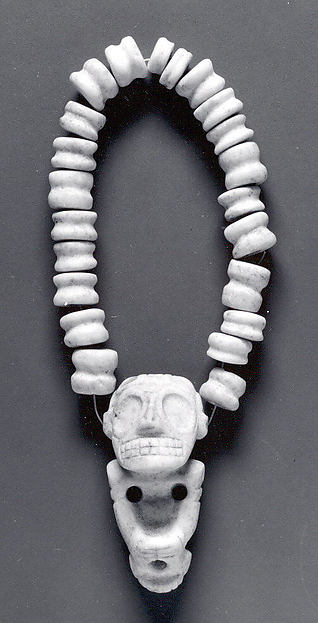
A necklace of white stone beads hung with a small carved figure, made by the people of these islands before the fleet came, in the 13th to 15th century.
A necklace of white stone beads hung with a small carved figure, made by the people of these islands before the fleet came, in the 13th to 15th century.Photograph by Taíno artist; The Metropolitan Museum of Art, 1983.544.2 (gift of Vincent and Margaret Fay), Jan. 1, 1200 · Public domain (Met Open Access, CC0)

SANTA CATALINA, CUBA.—The Admiral has had stones that shine like gold collected near Santa Catalina. “Without doubt, there is in these lands a vast quantity of gold,” he wrote on 12 November.

He saw them on Sunday in the bed of a stream and, remembering that there is gold in the Tagus near the sea, ordered some collected.

At the Río de Mares he saw no gold, though one man had a piece of worked silver fastened to his nose. He ordered nothing taken, so the people would understand he sought only gold, which they call nucay. Old men shown gold and pearls said there was an infinite quantity at Bohio, worn on necks, ears, arms and legs.

Without doubt, there is in these lands a vast quantity of goldDon Cristóbal Colón, Admiral of the Ocean Sea

The Indians aboard talk much of the island of Babeque, where, he writes, “the people gather the gold on the beach at night with candles, and afterwards beat it into bars with hammers”. He sailed for it on 12 November.

Columbus's Journal of the voyage (Las Casas abstract, tr. Markham, rev. in Olson & Bourne, 1906).

Admiral urges the Sovereigns to keep these lands for Christians

Reconstructed from historical sources

The great round map of the world made by the monk Fra Mauro at Murano, Venice, finished by 1459 and drawn with south at the top: Cathay and the islands of the Indian Sea, Africa and Europe, ringed by the Ocean.
The great round map of the world made by the monk Fra Mauro at Murano, Venice, finished by 1459 and drawn with south at the top: Cathay and the islands of the Indian Sea, Africa and Europe, ringed by the Ocean.Photograph by Fra Mauro, monastery of San Michele, Murano, Venice; Biblioteca Nazionale Marciana. Photograph: Sailko, 2016, Dec. 31, 1459 · CC BY 3.0

PUERTO DEL PRÍNCIPE, CUBA.—The Admiral is urging the King and Queen to hold these lands for the Faith. “It is very clear that no one before has been so far as this by sea,” he writes.

He finds the people guileless and unwarlike, and urges the Sovereigns to bring these nations into the Church: “if devout religious persons were here, knowing the language, they would all turn Christians”.

He calls the Río de Mares the best port he has yet seen, an excellent site for a town and fort, rich in mastic, cotton and aloes, and the cotton could be sold to the great cities of the Great Khan. A fortress on its high rocky cape would keep merchants safe from other nations, he says, if the place became rich.

It is very clear that no one before has been so far as this by seaDon Cristóbal Colón, Admiral of the Ocean Sea

On 14 November he came on a deep opening among high, wooded islands too many to count. He believes them the countless islands the maps of the world show in the Far East, rich in stones and spices, and named the sea La Mar de Nuestra Señora and the haven Puerto del Príncipe.

On Tuesday 27 November he wrote: “Your Highnesses ought not to consent that any stranger should trade here, or put his foot in the country, except Catholic Christians.”

Columbus's Journal of the voyage (Las Casas abstract, tr. Markham, rev. in Olson & Bourne, 1906).

Indians aboard dread the one-eyed men of Bohio

AT SEA, OFF CUBA.—The Indians the Admiral carries say Bohio is very large, with people who have one eye in their foreheads and others who eat men, of whom they are much afraid. They greatly fear the people of Caniba, who they say live in Bohio and come to take people from their homes: “They declared that the Canibas had only one eye and dogs’ faces.” The Admiral thought they lied, and inclines to think the raiders come from the Great Khan’s dominions.

Columbus's Journal of the voyage (Las Casas abstract, tr. Markham, rev. in Olson & Bourne, 1906).

A man’s head in a basket, and a cake of wax

ON THE COAST OF CUBA.—On Thursday 29 November, in the rain, Christians found a village to the N.W. empty. They caught an old man, told him they meant no harm, gave him presents and let him go. They took a cake of wax for the Sovereigns, and found “the head of a man in a basket, covered with another basket, and fastened to a post of the house.” The Admiral believes such heads are of a founder or chief ancestor of a lineage.

Columbus's Journal of the voyage (Las Casas abstract, tr. Markham, rev. in Olson & Bourne, 1906).

A new mast for the Niña, and not a man sick

WITH THE FLEET.—At Santa Catalina the Admiral got a new mast and yard for the Niña’s mizzen. On 27 November he wrote: “I thank our Lord that, up to this time, there has not been a person of my company who has had so much as a headache, or been in bed from illness.”

Columbus's Journal of the voyage (Las Casas abstract, tr. Markham, rev. in Olson & Bourne, 1906).

Start Columbus Sails West from issue one tomorrow

Wayback Wire · No. 4 · November 1492