
WaybackWire

The news as it happened.

Columbus Sails WestDecember 1492Issue the Fifth

Admiral’s ship lost on a bank off Española at Christmas

Reconstructed from historical sources

The Admiral’s ship has been lost on a bank off La Isla Española at Christmas; with one vessel left, he is building a tower and a fort from her timbers and making ready to return to Castile.

A great ship under sail, of the kind that sails the Ocean Sea: an engraving made in the Low Countries about 1475 by the master who signs with a W and a key.
A great ship under sail, of the kind that sails the Ocean Sea: an engraving made in the Low Countries about 1475 by the master who signs with a W and a key.Photograph by Master W with the Key, Netherlandish engraver, Dec. 31, 1475 · Public domain (Wikimedia Commons)

OFF PUNTA SANTA, LA ISLA ESPAÑOLA, Monday.—Don Cristóbal Colón, Admiral of the Ocean Sea, has lost his own ship, the Santa María, on a bank off La Isla Española, and has one vessel left, the Niña.

He is hurrying on preparations for the return to Castile. Today he writes that, “as he had been left with only a single vessel, it did not appear prudent to encounter the dangers that are inevitable in making discoveries”. He lays the blame on the Pinta’s parting company.

She was lost in the night of Christmas Eve, Monday 24 December, lying about a league off Punta Santa with almost no wind. The Admiral speaks of “the sea as still as the water in a dish”.

as he had been left with only a single vessel, it did not appear prudent to encounter the dangers that are inevitable in making discoveriesDon Cristóbal Colón, Admiral of the Ocean Sea

At about eleven he went to rest, having had no rest for two days and a night. The sailor at the helm then left the tiller to a boy, a thing the Admiral had forbidden throughout the voyage.

The current carried the ship on to a bank. The boy felt the helm and heard the sea, and cried out; the Admiral came up at once.

He ordered the master, whose watch it was, to lay out an anchor astern. Instead the master and others took the boat and rowed for the caravel, half a league to leeward. She would not take them in and they turned back, but the caravel’s own boat reached the ship first.

The masts were cut away and the ship lightened. The Admiral writes: “Then the timbers opened, and the ship was lost.” He went across to the caravel and hove her to until daylight.

He says the ship would have been saved had the master and his boat’s crew laid out the anchor as ordered. She was heavy and unsuited for discovery, he adds, and the people of Palos forced her on him.

Columbus's Journal of the voyage (Las Casas abstract, tr. Markham, rev. in Olson & Bourne, 1906) · Churchill's Collection of Voyages and Travels, vol. 2 (London, 3rd ed., 1744): 'The History of the Life and Actions of Admiral Christopher Columbus', by his son Ferdinand Columbus (English translation) · Churchill's Collection of Voyages and Travels, vol. 2 (London, 3rd ed., 1744): 'The History of the Life and Actions of Admiral Christopher Columbus', by his son Ferdinand Columbus (English translation) · Olson and Bourne, eds., The Northmen, Columbus and Cabot, 985-1503 (Scribner's, 1906): Articles of Agreement and Title (from Navarrete, translated by George F. Barwick).

A tower and a fort from the wreck, and men to stay behind

Reconstructed from historical sources

PUNTA SANTA, LA ISLA ESPAÑOLA.—The Admiral writes that “in truth, the disaster was really a piece of good fortune”. Without it he would not have anchored here or left people in the country, and many of his men have asked leave to remain.

On Wednesday he resolved to build a tower from the timber of the wrecked ship and leave Christians here to trade and learn the language. “Now I have given orders for a tower and a fort, both well built, and a large cellar,” he writes.

The fort is to have bread and wine for more than a year, seeds, the ship’s boat, a caulker, a carpenter, a gunner and a cooper. He hopes to find a tun of gold gathered by barter when he comes back from Spain, and renews his protest that the gain go to the conquest of Jerusalem.

in truth, the disaster was really a piece of good fortuneDon Cristóbal Colón, Admiral of the Ocean Sea

On Friday he went ashore to hurry on the work and settle who should remain, and was received by the king’s brother in the town’s best house, set aside for the Spaniards.

Columbus's Journal of the voyage (Las Casas abstract, tr. Markham, rev. in Olson & Bourne, 1906) · Churchill's Collection of Voyages and Travels, vol. 2 (London, 3rd ed., 1744): 'The History of the Life and Actions of Admiral Christopher Columbus', by his son Ferdinand Columbus (English translation).

King Guacanagarí weeps for the Admiral’s loss, and crowns him

Reconstructed from historical sources

A chief's low carved wooden seat, with a grinning face at the front and spirals on the shoulders, made in these islands in the 14th or 15th century, before the fleet came.
A chief’s low carved wooden seat, with a grinning face at the front and spirals on the shoulders, made in these islands in the 14th or 15th century, before the fleet came.Photograph by Taíno artist; shown in the Louvre, Paris (Arts of Africa, Asia, Oceania and the Americas). Photograph: Sailko, 2013, Jan. 1, 1300 · CC BY 3.0

THE KING'S TOWN, LA ISLA ESPAÑOLA.—Guacanagarí, the king who had invited the Admiral to his country, wept at the loss of the Admiral’s ship, and has since set his own crown on the Admiral’s head.

On Christmas morning the Admiral sent Diego de Arana of Córdoba, alguazil of the fleet, and Pero Gutiérrez, gentleman of the King’s bed-chamber, to the king’s town, a league and a half from the bank. The king wept, they reported, and sent all his people with many large canoes; all on deck was soon carried off.

He and his kin guarded the goods. The Admiral writes that “not a needle, nor a board, nor a nail was lost”.

not a needle, nor a board, nor a nail was lostDon Cristóbal Colón, Admiral of the Ocean Sea

The king has given the Christians two large houses. He spoke of the Caniba, whom they call Caribes, who come to capture his people; the Admiral had a lombard fired, and promised to defend him.

On Sunday, before five kings subject to him, all with their crowns, “the king took the crown off his head and put it on the Admiral’s head”. The Admiral gave him a fine cloak, coloured boots and a silver ring.

Of these people he tells the Sovereigns: “They love their neighbour as themselves”.

Columbus's Journal of the voyage (Las Casas abstract, tr. Markham, rev. in Olson & Bourne, 1906) · Churchill's Collection of Voyages and Travels, vol. 2 (London, 3rd ed., 1744): 'The History of the Life and Actions of Admiral Christopher Columbus', by his son Ferdinand Columbus (English translation).

Gold comes in by barter, and the king speaks of Cibao

Reconstructed from historical sources

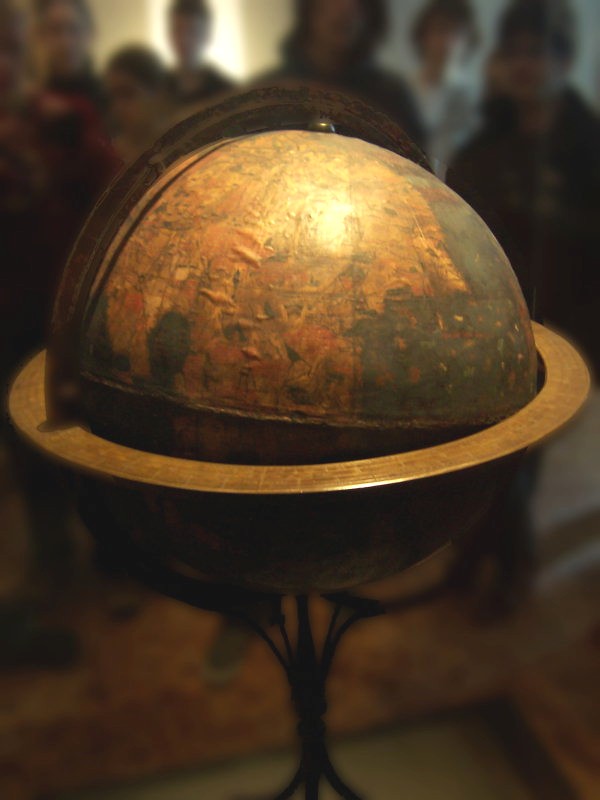
A globe made at Nuremberg by Martin Behaim between 1490 and this year, with Europe and Africa on one side of the Ocean Sea and Cipango on the other, islands scattered between.
A globe made at Nuremberg by Martin Behaim between 1490 and this year, with Europe and Africa on one side of the Ocean Sea and Cipango on the other, islands scattered between.Photograph by Globe by Martin Behaim, map painted by Georg Glockendon; Germanisches Nationalmuseum, Nuremberg. Photograph: Alexander Franke, 2006, Jan. 1, 1492 · CC BY-SA 2.0 DE

PUNTA SANTA, LA ISLA ESPAÑOLA.—The king has told the Admiral by signs that Cipango, which they call Cibao, has so much gold that it is of no value, and promised a great quantity from there.

Indians from another island brought gold for hawks’ bells. “They had scarcely come alongside when they called and held up the gold, saying Chuq chuq for the bells,” the Admiral writes. Ashore, a sailor said, a needle bought a piece of gold worth two castellanos.

The king has given a large mask with pieces of gold for the eyes and ears, and put a large soft piece of gold round the Admiral’s neck. The Admiral has at times suspected the king of hiding where the gold comes from, to keep him from trading elsewhere.

They had scarcely come alongside when they called and held up the gold, saying Chuq chuq for the bellsDon Cristóbal Colón, Admiral of the Ocean Sea

On 23 December a chief told him of a great quantity of gold on Española. The Admiral wrote: “May our Lord favor me by his clemency, that I may find this gold, I mean the mine of gold, which I hold to be here”.

Columbus's Journal of the voyage (Las Casas abstract, tr. Markham, rev. in Olson & Bourne, 1906) · Churchill's Collection of Voyages and Travels, vol. 2 (London, 3rd ed., 1744): 'The History of the Life and Actions of Admiral Christopher Columbus', by his son Ferdinand Columbus (English translation).

Admiral crosses to a great island and names it La Isla Española

Reconstructed from historical sources

A carved wooden figure of a spirit, crouching with a bowl on its head and shell set in its eyes and teeth, made by the people of these islands about the year 1000, long before the fleet came.
A carved wooden figure of a spirit, crouching with a bowl on its head and shell set in its eyes and teeth, made by the people of these islands about the year 1000, long before the fleet came.Photograph by Taíno artist; The Metropolitan Museum of Art, 1979.206.380 (Michael C. Rockefeller Memorial Collection), Dec. 31, 1000 · Public domain (Met Open Access, CC0)

MAR DE SANTO TOMÁS, LA ISLA ESPAÑOLA.—The Admiral has named the great island he reached La Isla Española, finding there “the most beautiful champaign country, almost like the lands of Spain: these even have the advantage”.

He left Cuba on Wednesday 5 December for a very large island to the S.E. the Indians call Bohio.

The land is like Castile’s, with ilex and myrtles; at Puerto de la Concepción a mullet like those of Spain jumped into the boat, and nightingales sang. There, on Wednesday 12 December, he set up a great cross in sign of possession.

the most beautiful champaign country, almost like the lands of Spain: these even have the advantageDon Cristóbal Colón, Admiral of the Ocean Sea

At first the people fled and lit fires on the heights. At the Mar de Santo Tomás, which he calls the best harbour in the world, they came down until they covered the ground, bringing bread of yams and water in calabashes; many swam out half a league to the ship.

He ordered his men to annoy no woman, take nothing against anyone’s will and pay for all. Islanders in canoes cried: “Take it! take it!”

Columbus's Journal of the voyage (Las Casas abstract, tr. Markham, rev. in Olson & Bourne, 1906).

A woman brought aboard is sent home, and her village gives thanks

PUERTO DE LA CONCEPCIÓN, LA ISLA ESPAÑOLA.—On Wednesday 12 December a woman of the island was brought aboard. The Admiral had her dressed and sent her ashore with gifts. He writes that she “did not want to leave the ship, but would rather remain with the other women he had seized at the port of Mares”. Next day his men found her village of a thousand houses, and her husband came with a great crowd to thank them.

Columbus's Journal of the voyage (Las Casas abstract, tr. Markham, rev. in Olson & Bourne, 1906).

The Pinta reported in a river at the island’s end

LA ISLA ESPAÑOLA.—Five weeks after Martín Alonso Pinzón took the Pinta away, the Admiral writes that on Thursday 27 December “the news came that the caravel Pinta was in a river at the end of this island”. Guacanagarí sent a canoe there with one of the Admiral’s men. His brother and a close kinsman dined aboard and said they wished to go to Castile.

Columbus's Journal of the voyage (Las Casas abstract, tr. Markham, rev. in Olson & Bourne, 1906) · Churchill's Collection of Voyages and Travels, vol. 2 (London, 3rd ed., 1744): 'The History of the Life and Actions of Admiral Christopher Columbus', by his son Ferdinand Columbus (English translation).

Start Columbus Sails West from issue one tomorrow

Wayback Wire · No. 5 · December 1492