
WaybackWire

The news as it happened.

Europe Goes to WarFriday, July 31, 1914Issue the Eighth

Russia calls up her whole army

Germany proclaims a state of war

Russia calls up her whole army and fleet, Germany proclaims a state of war, the world’s exchanges close, and M. Jaures is shot dead in Paris.

LONDON, Friday.—Russia has called up her whole army and fleet, and a state of war has been proclaimed in Germany.

Mr Asquith gave the news to the House of Commons to-day as he moved the adjournment: “Russia has proclaimed a general mobilisation of her Army and Fleet”. It came not from St Petersburg but from Germany, he said, and the Government understands that German mobilisation will follow if the Russian mobilisation is general and is proceeded with. The House has adjourned until Monday.

A dispatch from Berlin to Reuter’s agency says the state of war has been proclaimed in Germany. It brings measures to protect the frontier and the railways, restricts the post, telegraph and railways in favour of the army, and forbids the publication of troop movements and means of defence.

Russia has proclaimed a general mobilisation of her Army and FleetMr H. H. Asquith, Prime Minister, in the House of Commons

From St Petersburg comes word that “Russia’s mobilisation is not partial, but absolute.” The general reservists of the northern districts are summoned, and the Tsar goes to Moscow to deliver a pronouncement in the Uspensky Cathedral.

The German Ambassador there is understood to have protested on Wednesday that a partial mobilisation would force Germany to mobilise. M. Sazonoff replied that mobilisation had begun on Wednesday and could not now be stopped.

War fever seized the Russian capital when the mobilisation was announced, and it “increased almost to delirium” on the news that the British fleet had sailed.

In Berlin about five thousand people gathered before the palace and cheered the Emperor, who appeared at a window and spoke to them. “A fateful hour has fallen for Germany. Envious peoples everywhere are compelling us to our just defense. The sword has been forced into our hands,” the Kaiser said.

“War would demand of us an enormous sacrifice in property and life, but we should show our enemies what it means to provoke Germany.”

He told them to go to church and pray for the army. The Reichstag is summoned to meet on Tuesday at the Royal Palace to hear the decision of the Emperor and the Bundesrath and, if necessary, to vote a war credit.

UK Parliament, House of Commons (Hansard), July 31 · Evening Star (Washington, D.C.), July 31 · De Tijd (Amsterdam), Aug. 1 · Taranaki Daily News (New Plymouth, NZ), Aug. 1 · Evening Star (Washington, D.C.), Aug. 1 · Evening Star (Washington, D.C.), Aug. 1
M. Jaures, the Socialist leader, shot dead in a Paris cafe

PARIS, Friday night.—M. Jaures, leader of the French Socialists and an opponent of the three-year military service law, was shot dead this evening as he sat at a small table in the Cafe du Croissant.

A man fired several revolver shots at him, and a couple of bullets entered his head. He died soon after.

The police had to rescue the assassin from the crowd, which shouted “Assassin” and “Death to the assassin.” Arrested at once, he at first refused to give his name. He is said to be a young man named Raoul Villain.

Paris rages with the war feverParis dispatch

As the news spread there were cries of “Viva Jaures” and a demonstration before the offices of L’Humanite and on the boulevards. The Minister of the Interior left the Council of Ministers to give orders to prevent demonstrations, and the Government will post a proclamation on the walls of Paris expressing its horror at the attack and urging absolute calm.

Earlier in the day a dispatch reported: “Paris rages with the war fever.” No mobilisation order has been issued, but the barracks are crowded with reservists awaiting the call and business is at a standstill. Telephone communication between France and Germany has been interrupted since four o’clock this afternoon.

Limburger koerier (Maastricht), Aug. 1 · Het nieuws van den dag: kleine courant (The Hague), Aug. 1 · Norwich Bulletin (Norwich, Conn.), Aug. 1 · Perth Amboy Evening News (Perth Amboy, N.J.), July 31 · Evening Star (Washington, D.C.), July 31

Stock exchanges close from London to New York; Bank rate 8 per cent

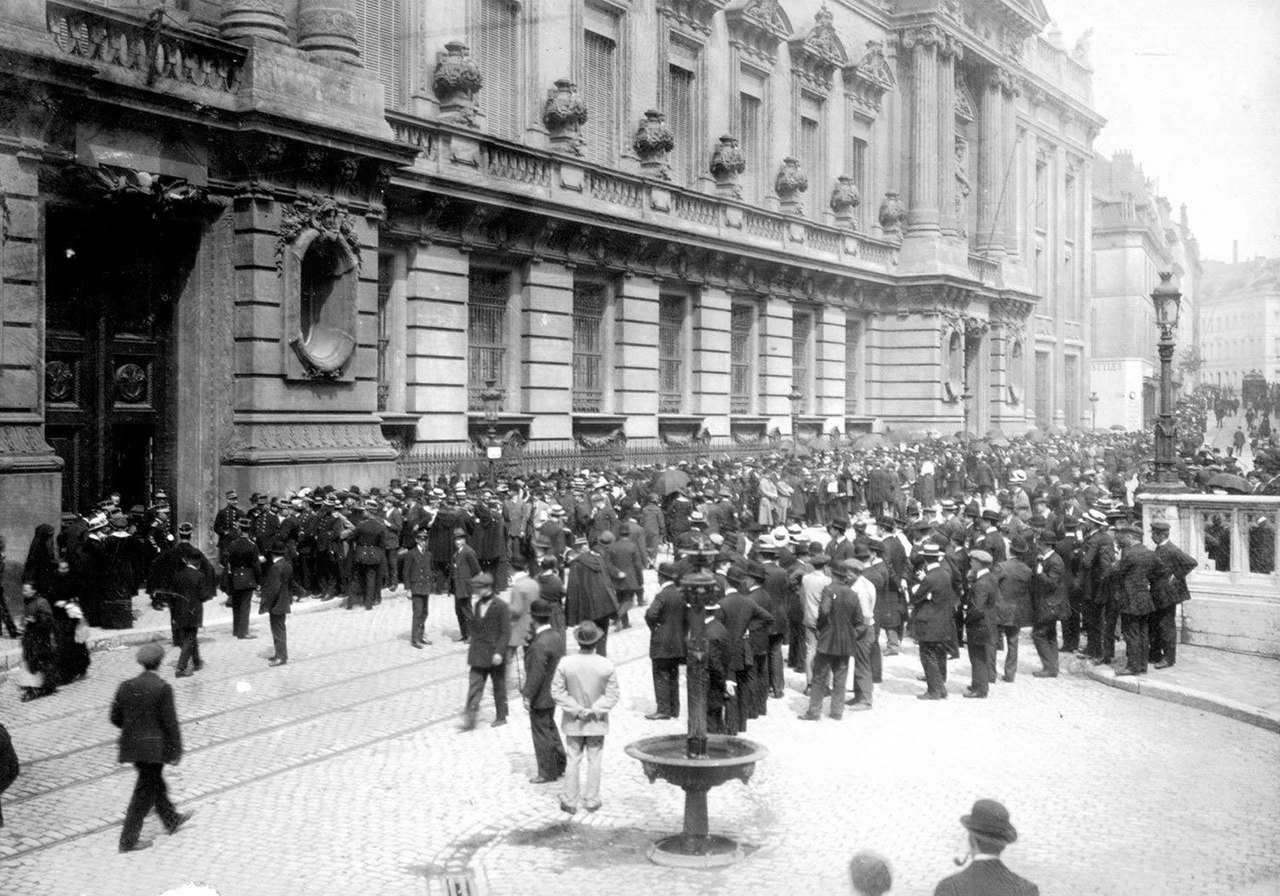
A crowd of depositors outside the head office of the Banque Nationale in the rue du Bois Sauvage, Brussels, 31 July 1914.
A crowd of depositors outside the head office of the Banque Nationale in the rue du Bois Sauvage, Brussels, 31 July 1914.Photograph by Unknown (via history.2014-18brussels.be), July 31, 1914 · Public domain

LONDON, Friday.—The London Stock Exchange has closed for the first time in its history, and every exchange in England and Scotland shut on learning of London’s action. The Bank of England rate has been doubled, from 4 to 8 per cent, and short loans commanded 10 and 10 1/2 per cent.

Depositors wanting gold instead of notes made the scene at the Bank look almost like a run. Very few banks are paying anything but notes, and Monday is a bank holiday. A governor of the Bank is the authority for the statement that the banking act will virtually certainly be suspended and that the Bank will issue one-pound notes.

In New York the Stock Exchange has closed, the first time since 1873 that business has been suspended for a full day. The decision was reached at a meeting of bankers at the offices of J. P. Morgan and Company. “The governing committee decided that the exchange be closed until further notice, and that all deliveries be suspended until further notice.”

The governing committee decided that the exchange be closed until further notice, and that all deliveries be suspended until further noticeAnnouncement of the New York Stock Exchange

“The National bank is besieged by 10,000 persons demanding their money,” a Brussels dispatch reports. In Paris the Bank of France is putting 20- and 5-franc notes into circulation, and savings-bank withdrawals are limited to 50 francs a fortnight, on 15 days’ notice.

The Economist judges: “The shock so far has been well resisted, but the crisis cannot continue indefinitely without a serious strain on credit.”

Daily Kennebec Journal (Augusta, Maine), Aug. 1 · The Washington Times (Washington, D.C.), July 31 · Evening Star (Washington, D.C.), July 31 · South Bend News-Times (South Bend, Ind.), July 31 · Taranaki Daily News (New Plymouth, NZ), Aug. 1 · The Economist (London), Aug. 1

Guard on the Bombay dockyard as the Guides reach Penang

BOMBAY, Friday.—A special guard of the Sherwood Foresters has been posted at the Government Dockyard here since yesterday afternoon, and the officers and crew of H.M.S. Dartmouth are busy fitting her for her passage to home waters.

“Last night all soldiers in the garrison who were out in the city were recalled to barracks. The reason for this order did not transpire,” the Bombay Chronicle reports. Commercial circles are much troubled, though shipping bookings are not yet affected.

At Penang, ‘B’ Company of the Malay States Guides has arrived with war material and is encamped at the Fort until further orders.

Last night all soldiers in the garrison who were out in the city were recalled to barracks. The reason for this order did not transpireThe Bombay Chronicle

In Singapore marine insurance on Russian and Austrian ships has risen by no less than 300 per cent in three days. “Rates now vary from hour to hour and it is impossible to fix any quotation ahead,” the Straits Times finds.

Across the Empire, Australia has recalled the warships Australia, Encounter and Melbourne from the Queensland coast, and at Ottawa the Militia Council has ordered preparations as volunteers pour in. The Transvaal manoeuvres have been cancelled. “The Conservative Press unanimously declares that if Britain is involved in war Canada must assist, no matter at what cost,” a cable from Ottawa runs.

The Bombay Chronicle, July 31 · Pinang Gazette and Straits Chronicle, July 31 · The Straits Times, July 31 · Taranaki Daily News (New Plymouth, NZ), Aug. 1

Comment: The London papers divided over Britain’s duty

LONDON, Friday.—The London morning papers are divided over what Britain owes her friends. “We must stand by our friends, if only because without their aid we cannot be safe,” says the Daily Mail, and the Morning Post holds that the general intention of Englishmen is not to look on at the crushing of France.

The Daily News answers that none but the weightiest reasons could drive Britain into the conflict, and that honour, principle and interest dictate neutrality. The Daily Citizen calls on the workers to “wage war against war”. A meeting of Liberal members has objected strongly to the assumption in the press that Britain is under treaty obligation to take part.

Lord Lamington, in a letter to the newspapers, holds that fidelity to the Entente requires Britain to take part, yet he writes: “The safety of India and the overseas dominions is of greater importance than the possible defeat of France.”

Taranaki Daily News (New Plymouth, NZ), Aug. 1, 1914.

Britain makes ready in silence

LONDON, Friday.—Dover harbour has been cleared and cross-Channel steamers put in at Folkestone, and troops from Shorncliffe have gone to Queenborough and other eastern ports. The papers print nothing of dockyard work or ship movements: “The actual steps taken it would be unpatriotic to mention,” The Times says. The King has given his assent to the Finance Bill and other bills, so that Parliament is free to deal with any extraordinary measures.

The Washington Times · Evening Star (Washington, D.C.); all July 31, 1914.

Belgrade magazine explodes

VIENNA, Friday.—Vienna states officially that after renewed machine-gun fire at midnight the Austrian monitors replied, a magazine exploded at one in the morning, and at dawn the Servians tried without success to destroy the bridge. “Our artillery demolished the Customs House in reply to shots therefrom,” says the official telegram.

The Singapore Free Press and Mercantile Advertiser, Aug. 1 · Pinang Gazette and Straits Chronicle, July 31

Belgium mobilises; Germany bans exports

BRUSSELS, Friday.—The Belgian Government has resolved on a general mobilisation. In Berlin the Federal Council has forbidden, with immediate effect, the export of grain, flour, foodstuffs, meat, animal products, motor trucks, motor cycles, petroleum, coal tar and coal oils.

Groninger dagblad, Aug. 1 · Evening Star (Washington, D.C.), July 31

  • SINGAPORE: The Russian naval cadets who have spent a fortnight in the colony sailed for home on Friday morning in the Russian Volunteer liner Koursk. As their motors left the Sailors’ Home, “Singapore in general, and Capt. Hudson, the Superintendent, in particular, received three rousing cheers,” the Malaya Tribune reports.

    Malaya Tribune, July 31, 1914.

Start Europe Goes to War from issue one tomorrow

Wayback Wire · No. 8 · Friday, July 31, 1914