WaybackWire

The news as it happened.

The 300 and SalamisThe week to 7 September 480 BCIssue the First

Allies hold the pass at Thermopylae as the king comes south

Reconstructed from historical sources

The Greek allies hold the pass at Thermopylae and the strait off Artemisium as the Persian king comes down into Thessaly.

A modern photograph of the cliffs above the warm springs at Thermopylae, the pass the Greeks have chosen to hold.
A modern photograph of the cliffs above the warm springs at Thermopylae, the pass the Greeks have chosen to hold.Photograph by Ronny Siegel · CC BY 3.0

THERMOPYLAE.—The Greek allies stand across the Persian king’s road. Leonidas, king of Sparta, holds the pass at Thermopylae with the allied army, and the allied fleet lies close by off Artemisium.

The army broke up from the Isthmus with all speed on word that the king was in Pieria, and has now reached the pass and dug in. The two stations are so near each other that each can have word of what the other is doing.

The allied council chose the place itself. It judged this pass narrower than the way into Thessaly and nearer home, and found on a survey that here the king could use neither his whole army nor his horsemen.

if on men’s valour, then this number will doLeonidas

At its narrowest the road is fifty feet wide. A high, sheer spur of Oeta rises on one side; on the other there is nothing but marsh and sea. Here are the warm springs called the Basins, and an altar of Heracles.

Across the road the men have built up again the old wall the Phocians once raised against the Thessalians, mostly in ruins until now, to bar the foreigner’s way into Hellas. For food they look to the village of Alpeni, close by the road behind them.

Leonidas, son of Anaxandrides, has brought the appointed three hundred, men he picked himself, all of them men with sons.

Beside the Spartans stand 700 Thespians, 400 Thebans, 400 Corinthians and men from all over Arcadia, with others from the Peloponnese.

Someone in the camp asked Leonidas whether he meant to run so great a risk with so few men against so many. If he trusted in numbers, he answered, all Greece would not suffice, being but a small part of the enemy’s host; “if on men’s valour, then this number will do.”

Herodotus, Histories, book 7, tr. A. D. Godley (Loeb, 1920; modernised by Perseus) · Plutarch, Sayings of Spartans, in Moralia, tr. F. C. Babbitt (Loeb, 1931).

Allied fleet of 271 ships takes station off Artemisium

Reconstructed from historical sources

A modern photograph of the beach at Cape Artemisium in northern Euboea, looking across the strait to the mountains of Magnesia.
A modern photograph of the beach at Cape Artemisium in northern Euboea, looking across the strait to the mountains of Magnesia.Photograph by Marco Prins, Livius.org · CC0

ARTEMISIUM.—The allied fleet, 271 warships besides the fifty-oared boats, has taken station at Artemisium, in the country of Histiaea on the north of Euboea.

Athens sends 127 ships, with the Plataeans rowing beside her own men, and has found the ships for Chalcis besides. Corinth sends 40 and Aegina 18; Sparta sends 10.

The chief command goes to a Spartan, Eurybiades son of Euryclides. The allies said they would sooner break up the fleet than follow Athenians, and the Athenians have waived their claim, holding the safety of Hellas to come first.

Themistocles of Athens has given up his own command to Eurybiades, and has soothed his countrymen with a promise: if they prove brave in this war, he will bring the Greeks to follow them willingly afterwards.

From the first Themistocles wanted to embark the citizens and meet the king at sea, as far from Greece as might be, and many opposed him. Since the march to Tempe came to nothing, Athens has warmed to his naval plan, and he has been sent with the fleet to watch the narrows.

Herodotus, Histories, book 8, tr. A. D. Godley (Loeb, 1920; modernised by Perseus) · Plutarch, Life of Themistocles, tr. Bernadotte Perrin (Loeb, 1914).

Ships, by city

Athens127
Corinth40
Megara20
Chalcis (ships from Athens)20
Aegina18
Sicyon12
Sparta10
Others24

271 warships, besides fifty-oared boats from Ceos and the Opuntian Locrians. Others: Epidaurus 8, Eretria 7, Troezen 5, Styra 2, Ceos 2.

Herodotus, Histories, book 8, tr. A. D. Godley (Loeb, 1920; modernised by Perseus).

Locrians and Phocians march to join the army at the pass

Reconstructed from historical sources

THERMOPYLAE.—The army in the pass has grown. The Opuntian Locrians have come in full force and the Phocians with 1,000 men, answering a summons from the allies.

The allied messengers told them this was only the advance guard, with the rest expected any day, and that the Athenians, the Aeginetans and the fleet were watching the sea. “The invader of Hellas was not a god but a human being,” they said, and a man is certain to fall from pride.

For the Locrians who live by the pass, it is a change of side. They had given earth and water to the king, and had promised to seize the passes for him before he came.

The invader of Hellas was not a god but a human beingAllied messengers to the Locrians and Phocians

Only on reaching the pass did the Greeks learn, from the men of Trachis, of a path over the mountain. The Phocians, defending their own country, have promised Leonidas of their own accord to guard it.

The main armies follow later. Sparta sent Leonidas ahead so that the other allies would see the Spartans march and not go over to the Persians. Once the Carneia festival is over, the Spartans mean to leave a garrison at home and march out in full force; the other allies mean to do the same once the Olympic festival is past.

Herodotus, Histories, book 7, tr. A. D. Godley (Loeb, 1920; modernised by Perseus) · Diodorus Siculus, Library of History, book 11, tr. C. H. Oldfather (Loeb, 1946).

The king marches from Therma into Thessaly

Reconstructed from historical sources

Spearmen of the Persian king's guard, each with bow and quiver on his back, in glazed brick from the palace of Darius at Susa, c. 510 BC. A modern museum photograph. Louvre, Paris, AOD 488.
Spearmen of the Persian king’s guard, each with bow and quiver on his back, in glazed brick from the palace of Darius at Susa, c. 510 BC. A modern museum photograph. Louvre, Paris, AOD 488.Photograph by Jastrow, at the Musée du Louvre · Public domain (released by the photographer)

THE ISTHMUS OF CORINTH.—The Persian king, Xerxes, has left Therma with his army and is coming down into Thessaly by the upper road through the Macedonian highlands, the way he was told was safest.

The road runs by the Perrhaebi and Gonnus. For many days a third of his army had been cutting it over the mountains while he waited in Pieria, where his heralds came back to him, some empty-handed, some bearing earth and water.

His fleet, reckoned at 1,207 triremes, lies at Therma awaiting orders.

Men of Hellas, the pass of Olympus must be guarded so that Thessaly and all Hellas may be sheltered from the warThessalian envoys to the council at the Isthmus

Thessaly is already his. The Thessalian envoys had pleaded with the council at the Isthmus: “Men of Hellas, the pass of Olympus must be guarded so that Thessaly and all Hellas may be sheltered from the war.”

The allies answered by sending about 10,000 men-at-arms, with horsemen, to hold the vale of Tempe between Olympus and Ossa, under Euaenetus son of Carenus of Sparta and Themistocles of Athens.

They stayed only a few days. Messengers from Alexander son of Amyntas, the Macedonian, warned of the king’s numbers and advised them to go, and the Greeks learned of another way into Thessaly by Gonnus. They sailed back to the Isthmus, and the Thessalians, left alone, went over to the king.

Herodotus, Histories, book 7, tr. A. D. Godley (Loeb, 1920; modernised by Perseus).

Athens stakes its whole strength on the fleet

Reconstructed from historical sources

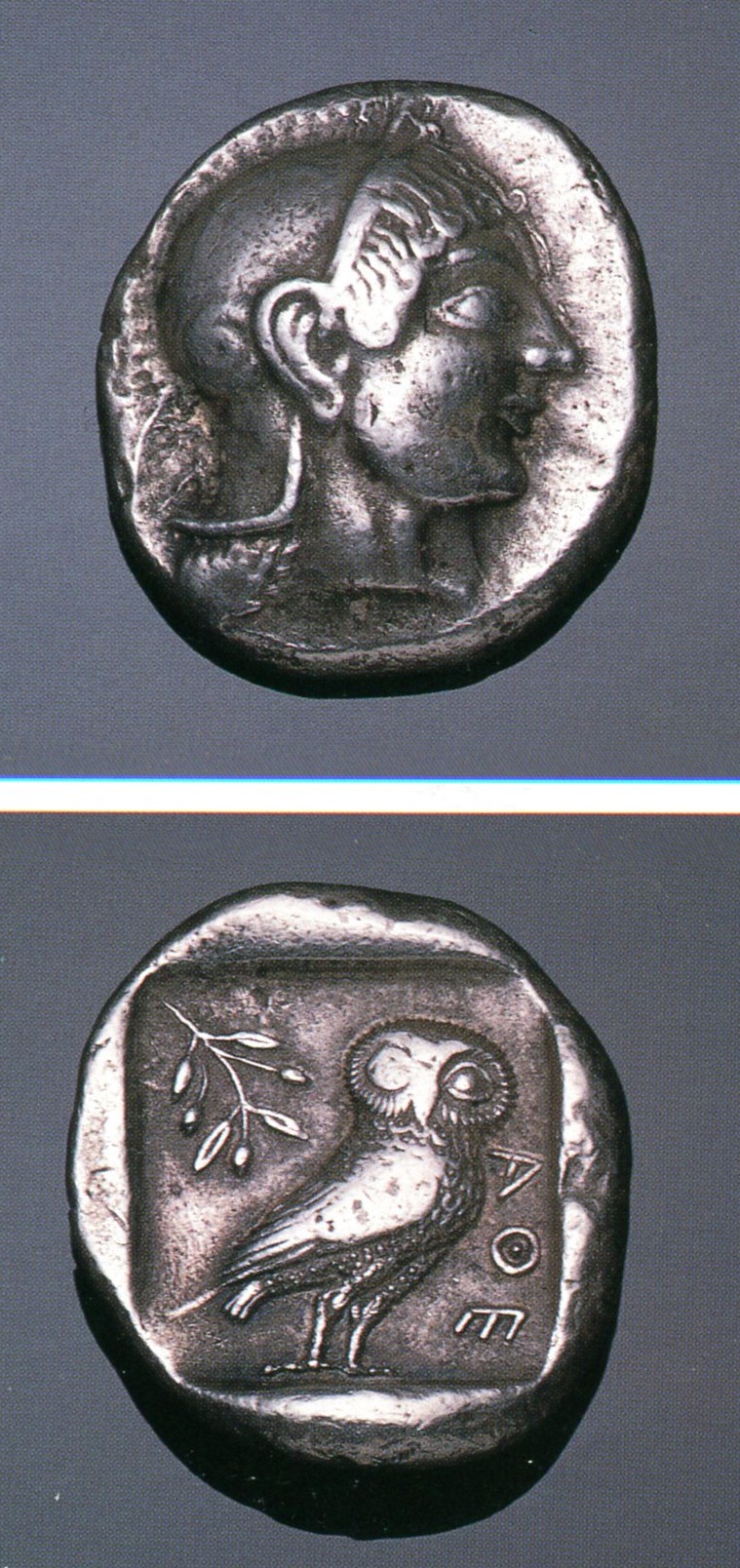
Silver four-drachma coin of Athens, c. 520-510 BC: the helmeted head of Athena, and her owl with an olive sprig. A modern photograph of a coin in private hands.
Silver four-drachma coin of Athens, c. 520-510 BC: the helmeted head of Athena, and her owl with an olive sprig. A modern photograph of a coin in private hands.Photograph by Exekias · CC BY 2.0

ATHENS.—Athens has put its whole strength into its ships, and the reason lies at Delphi. The priestess Aristonice first told the city’s envoys to flee, for fire and the god of war in a Syrian chariot would bring them low.

Dismayed, the envoys went back as suppliants on the advice of Timon son of Androbulus, vowing to stay until they died. The second answer said all within the border of Cecrops would be lost, “Yet a wood-built wall will by Zeus all-seeing be granted”, and called Salamis divine.

The city argued over it. Some elders held the wall to be the old thorn hedge round the acropolis; others said the ships, though the readers of oracles feared the last verses spelt defeat at sea near Salamis.

Yet a wood-built wall will by Zeus all-seeing be grantedThe priestess at Delphi

Themistocles son of Neocles answered that, had the verse meant ill for Athenians, it would have called Salamis cruel, not divine, and that the ships are the wooden wall. The city judged him the better counsellor. He had already persuaded Athens to build 200 ships with the Laurium silver rather than share it out at ten drachmae a head.

The vote was to trust in the god and meet the invader with the whole power of the fleet.

Herodotus, Histories, book 7, tr. A. D. Godley (Loeb, 1920; modernised by Perseus).

Thebans answer Leonidas’s call, 400 strong

THERMOPYLAE.—Leonidas has called out the Thebans, and their general, Leontiades son of Eurymachus, has brought 400 men to the pass. Leonidas took pains to bring them: Thebes stands accused of siding with the Mede, and he wished to learn whether the city would send its men or openly refuse the alliance.

Herodotus, Histories, book 7, tr. A. D. Godley (Loeb, 1920; modernised by Perseus).

Delphians told to pray to the winds

DELPHI.—The Delphians, afraid for themselves and for Hellas, consulted the god as the army and fleet set out, and were told to pray to the winds, which would be strong allies of Hellas. They sent the answer first to the Greeks who mean to stay free, and those Greeks, in dread of the foreigner, were grateful. The Delphians have raised an altar to the winds at Thyia and sacrifice to them there.

Herodotus, Histories, book 7, tr. A. D. Godley (Loeb, 1920; modernised by Perseus).

Allies swear to give Delphi the goods of Greeks who went over

THE ISTHMUS OF CORINTH.—Earth and water have been given to the king by the Thessalians, Dolopes, Enienes, Perrhaebians, Locrians, Magnesians, Melians, Achaeans of Phthia, the Thebans and all Boeotia but Thespiae and Plataea. The allies have sworn that, if they win, they will give the goods of every Greek who went over of his own free will to the god of Delphi. Their congress has ended all feuds among its members, the greatest the war between Athens and Aegina.

Herodotus, Histories, book 7, tr. A. D. Godley (Loeb, 1920; modernised by Perseus).

Start The 300 and Salamis from issue one tomorrow

Wayback Wire · No. 1 · The week to 7 September 480 BC