
WaybackWire

The news as it happened.

The 300 and SalamisThe week to 14 September 480 BCIssue the Second

The king camps at Trachis, face to face with the Greeks

Reconstructed from historical sources

The king’s army camps at Trachis facing the pass, the allied fleet falls back to Chalcis after losing its guard ships off Sciathus, and a storm rises over the Persian fleet off Magnesia.
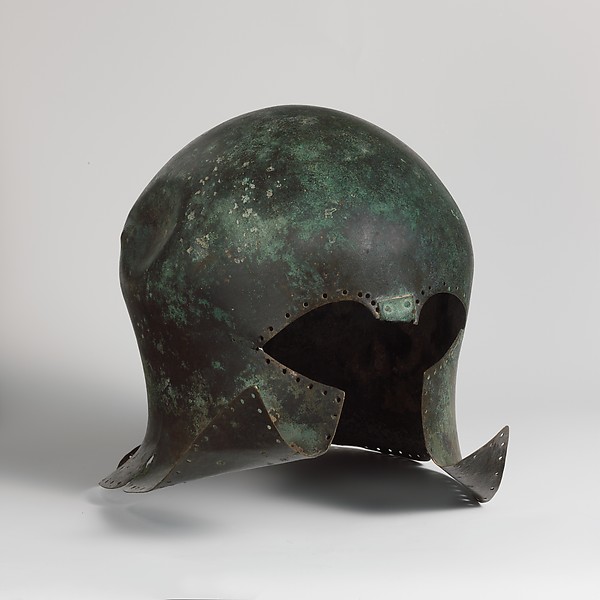
A bronze helmet of Corinthian type, of the kind worn by Greek men-at-arms, made c. 650-600 BC. A modern museum photograph. The Met, accession 20.51.2.
A bronze helmet of Corinthian type, of the kind worn by Greek men-at-arms, made c. 650-600 BC. A modern museum photograph. The Met, accession 20.51.2.Photograph by Greek workshop; photograph by The Metropolitan Museum of Art · Public domain (The Met Open Access, CC0)

THERMOPYLAE.—The Persian king and the Greek allies now face each other. Xerxes lies encamped with his army at Trachis in Malis, and the Greeks hold the pass.

Most Greeks call it Thermopylae; the people of the country call it Pylae. North of Trachis everything is the king’s, while the Greeks are masters of all that lies to the south on the mainland.

The king came down into Malis along a gulf where the tide ebbs and flows every day, shut in by high mountains known as the Rocks of Trachis. On reaching the Gulf of Malis he found the passes already held against him. Leonidas of Sparta and the allied army stand behind the rebuilt wall across the road.

Or do you not realize that the only men who fight against the enemy are those who respect and revere their kings?Leonidas

The king’s approach divided the council at the pass. As the Persians drew near, the rest of the Peloponnesians were for going back to the Peloponnese and guarding the Isthmus. The Phocians and the Locrians were greatly angered by that counsel.

Some of the commanders held that the army must wait for the rest of the allies. Leonidas asked them whether all who meant to fight were not already here. “Or do you not realize that the only men who fight against the enemy are those who respect and revere their kings?”

Leonidas voted to stay. He proposed that the army hold where it is and send messengers to the cities, bidding them send help, since the men in the pass are too few to hold off the army of the Medes. The army stays, and the call for help has gone out to the cities.

When someone in the camp told him that the Persians were near to them, the Spartan king answered: “Then we also are near to them.”

He told his men: “They say that the barbarian has come near and is comin’ on while we are wastin’ time.” And again: “Truth, soon we shall either kill the barbarians, or else we are bound to be killed oursel’s.”

Herodotus, Histories, book 7, tr. A. D. Godley (Loeb, 1920; modernised by Perseus) · Diodorus Siculus, Library of History, book 11, tr. C. H. Oldfather (Loeb, 1946) · Plutarch, Sayings of Spartans, in Moralia, tr. F. C. Babbitt (Loeb, 1931).

Three guard ships lost off Sciathus; fleet moves to Chalcis

Reconstructed from historical sources

A long-oared warship and a file of warriors with shields, painted on a mixing bowl made in Athens c. 775 BC. A modern museum photograph. The Met, accession 34.11.2.
A long-oared warship and a file of warriors with shields, painted on a mixing bowl made in Athens c. 775 BC. A modern museum photograph. The Met, accession 34.11.2.Photograph by Attic Geometric workshop; photograph by The Metropolitan Museum of Art · Public domain (The Met Open Access, CC0)

CHALCIS.—The allies have lost their three guard ships off Sciathus, and the fleet has left its station at Artemisium for Chalcis, to guard the Euripus.

Ten of the swiftest ships in the king’s fleet bore down on Sciathus, where the allied advance guard lay: one ship from Troezen, one from Aegina and one from Athens. The three took to flight as soon as they sighted the enemy.

The Troezenian ship, under Prexinus, was overtaken and taken at once. The Aeginetan trireme of Asonides gave its attackers trouble before it too was taken.

The Athenian trireme of Phormus ran aground at the mouth of the Peneus. The enemy took the hull, but the crew leapt ashore and escaped, and are making their way home to Athens overland through Thessaly.

Beacons from Sciathus carried the news to the fleet at Artemisium. Alarmed by it, the commanders shifted the anchorage to Chalcis and left watchmen on the heights of Euboea.

Herodotus, Histories, book 7, tr. A. D. Godley (Loeb, 1920; modernised by Perseus).

Storm rises over the king’s fleet off Magnesia

Reconstructed from historical sources

Warriors with helmets, shields and spears riding dolphins over the sea, painted by Oltos on a wine-cooler made in Athens c. 520-510 BC. A modern museum photograph. The Met, accession 1989.281.69.
Warriors with helmets, shields and spears riding dolphins over the sea, painted by Oltos on a wine-cooler made in Athens c. 520-510 BC. A modern museum photograph. The Met, accession 1989.281.69.Photograph by Oltos, Attic painter; photograph by The Metropolitan Museum of Art · Public domain (The Met Open Access, CC0)

EUBOEA.—A storm broke at dawn today over the coast of Magnesia, where the whole of the king’s fleet lay at anchor through the night.

The fleet sailed from Therma yesterday, eleven days after the king marched from there with his army.

After a full day’s sailing the ships reached Sepias in Magnesia and the beach that runs between the town of Casthanaea and the Sepiad headland.

The beach is not large. The first ships moored close in to land, and the rest rode at anchor behind them in rows eight ships deep, reaching out to sea.

The storm broke over that anchorage this morning, and the Greeks on Euboea saw it rising.

Herodotus, Histories, book 7, tr. A. D. Godley (Loeb, 1920; modernised by Perseus).

The king’s horses outrun the Thessalian cavalry

Reconstructed from historical sources

A horseman in a tall pointed cap and patterned eastern dress, painted inside a drinking cup by Psiax, Athens, c. 515 BC. A modern museum photograph. The Met, accession 14.146.1.
A horseman in a tall pointed cap and patterned eastern dress, painted inside a drinking cup by Psiax, Athens, c. 515 BC. A modern museum photograph. The Met, accession 14.146.1.Photograph by Psiax, Attic painter; photograph by The Metropolitan Museum of Art · Public domain (The Met Open Access, CC0)

THESSALY.—Word has come down from Thessaly of the king’s march south, and of a contest he held on the way.

In Thessaly the king raced his own horses against the Thessalian cavalry, which he had heard was the best in Hellas, to put it to the test. The Greek horses were far outpaced.

His army is so great that it drinks rivers low. Of all the Thessalian rivers, only the Onochonus failed to give his men enough to drink.

In Achaea even the greatest river, the Apidanus, gave out under the host and was left a sorry trickle.

Herodotus, Histories, book 7, tr. A. D. Godley (Loeb, 1920; modernised by Perseus).

Athenians at Chalcis call on the north wind

CHALCIS.—The Athenians stationed off Chalcis saw the storm rising and sacrificed to Boreas, the north wind, and to Orithyia, calling on them to destroy the barbarian fleet. An oracle had told them to summon their son-in-law as an ally, and by the Greek story Boreas took an Attic wife, Orithyia, daughter of Erechtheus.

Herodotus, Histories, book 7, tr. A. D. Godley (Loeb, 1920; modernised by Perseus).

Scyrian shows the king’s fleet the reef

EUBOEA.—Pammon of Scyros has shown the king’s fleet where the reef called the Ant lies. With the course past it marked, the whole fleet has sailed from Therma.

Herodotus, Histories, book 7, tr. A. D. Godley (Loeb, 1920; modernised by Perseus).

Start The 300 and Salamis from issue one tomorrow

Wayback Wire · No. 2 · The week to 14 September 480 BC