
WaybackWire

The news as it happened.

The 300 and SalamisThe week to 21 September 480 BCIssue the Third

Pass at Thermopylae lost

Leonidas of Sparta killed

Reconstructed from historical sources

The pass at Thermopylae falls and Leonidas is killed, while the allied fleet, after three days of sea fights off Artemisium, falls back to Salamis.
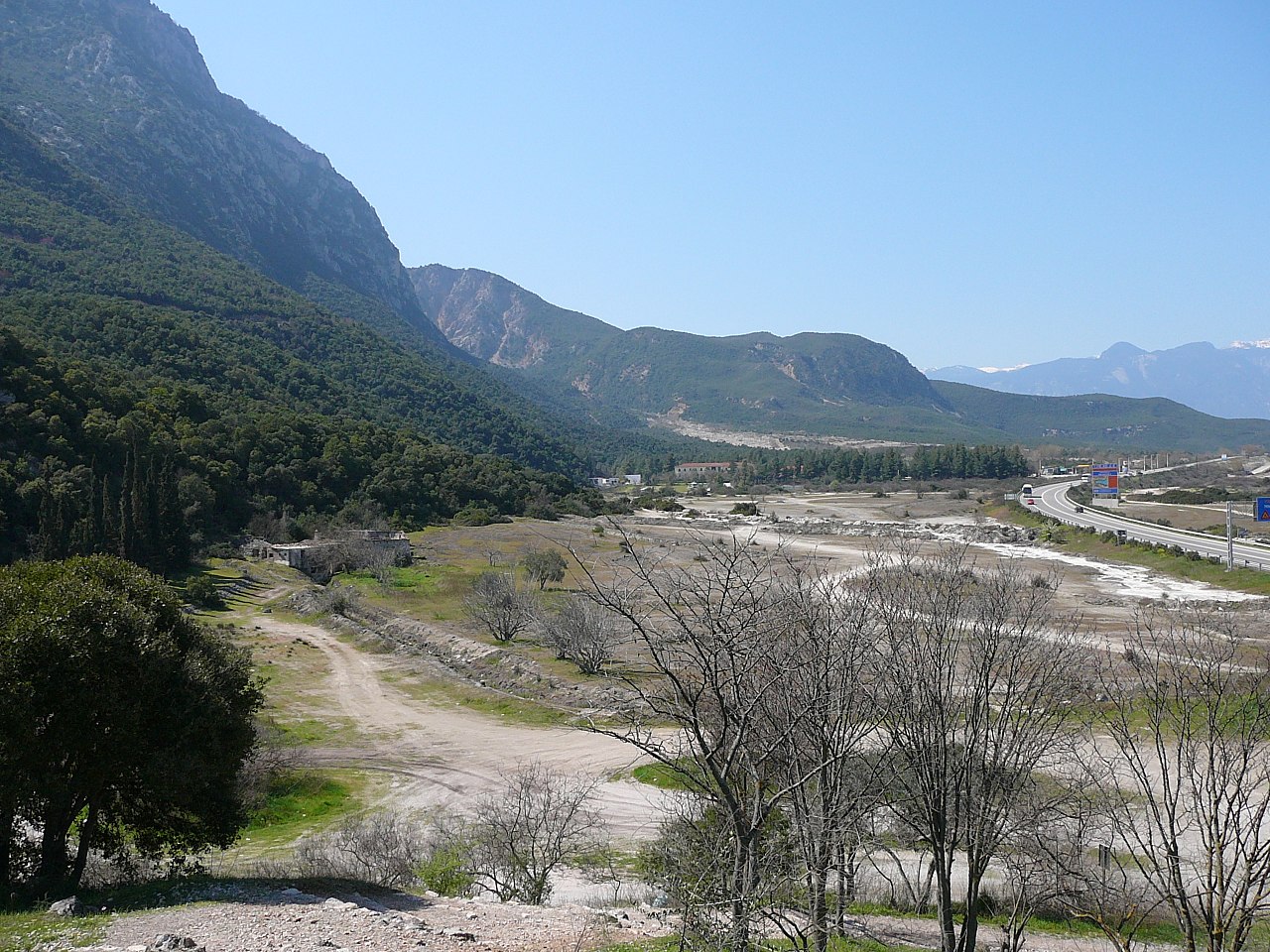
The pass at Thermopylae near the Phocian Wall, between the slopes of Mount Kallidromo and the plain, in a modern photograph. The sea then came up to where the modern road now runs, or closer.
The pass at Thermopylae near the Phocian Wall, between the slopes of Mount Kallidromo and the plain, in a modern photograph. The sea then came up to where the modern road now runs, or closer.Photograph by Photograph by Fkerasar (Wikimedia Commons) · CC BY-SA 3.0

THERMOPYLAE.—The pass at Thermopylae is in the king’s hands, and Leonidas, king of Sparta, is dead, killed with the men who stayed beside him on the third day of the fighting.

On the news from the pass, the allied fleet has left its station at Artemisium.

While it was still night, deserters came into the Greek camp with word that the Persians were making a circuit round the mountain, and at dawn the watchers came running down from the heights with the same news.

Or if not that, then the bound of Lacedaemon must mourn a dead king, from Heracles' lineThe priestess at Delphi

The seer Megistias, reading the sacrifices, told the Greeks that death was coming to them with the dawn.

The allies then parted. Some left for their own cities; others stayed with Leonidas. The Thespians, under their general Demophilus son of Diadromes, stayed of their own will, and Leonidas kept the Thebans back with him.

At sunrise the king poured libations, and he waited until about mid-morning before he attacked.

The Greeks fought with their spears until most of these were broken, and then with swords. Leonidas fell, and with him other Spartans of note. Two of the Persian king’s brothers fell too.

Over the body of Leonidas there was a great struggle. The Greeks dragged it clear and drove the enemy back four times. At the last they fought on with swords where they still had them, and with hands and teeth, until the enemy buried them under missiles.

When the war began, the priestess at Delphi told the Spartans that their city must be laid waste by Persian men. Her verse closed: “Or if not that, then the bound of Lacedaemon must mourn a dead king, from Heracles’ line.”

Word from the pass is that the king, told that the dead man had been king and general of the Lacedaemonians, ordered the head of Leonidas cut off and set on a stake.

Herodotus, Histories, book 7, tr. A. D. Godley (Loeb, 1920; modernised by Perseus) · Herodotus, Histories, book 7, tr. A. D. Godley (Loeb, 1920; modernised by Perseus) · Herodotus, Histories, book 8, tr. A. D. Godley (Loeb, 1920; modernised by Perseus).
Four days of waiting, then the king sends in the Medes

Reconstructed from historical sources

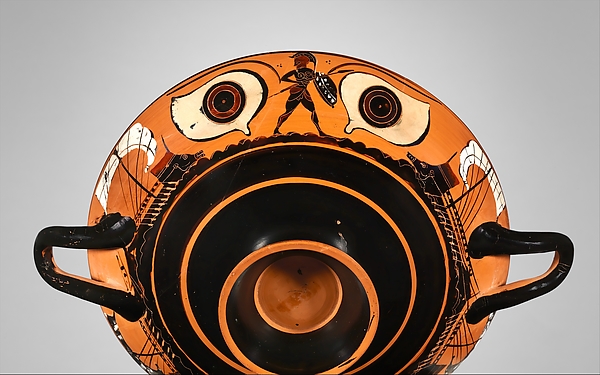
A Greek foot soldier with helmet and round shield running into action between two great painted eyes, on a drinking cup made in Athens c. 520 BC. A modern museum photograph. The Met, accession 56.171.36.
A Greek foot soldier with helmet and round shield running into action between two great painted eyes, on a drinking cup made in Athens c. 520 BC. A modern museum photograph. The Met, accession 56.171.36.Photograph by Attic painter; photograph by The Metropolitan Museum of Art · Public domain (The Met Open Access, CC0)

THERMOPYLAE.—For four days the king made no move from his camp at Trachis, expecting the Greeks in the pass to run away at any minute. They did not stir.

In those days letters passed between the two kings, it is reported from the Greek camp. Xerxes wrote offering Leonidas the rule of all Greece: “It is possible for you, by not fighting against God but by ranging yourself on my side, to be the sole ruler of Greece”.

Leonidas replied that he would sooner die: “for me to die for Greece is better than to be the sole ruler over the people of my race”. When the king wrote again, demanding that the Greeks give up their arms, Leonidas wrote back: “Come and take them”.

It is possible for you, by not fighting against God but by ranging yourself on my side, to be the sole ruler of GreeceXerxes

A Spartan, Dieneces, was told by a man of Trachis that the Persians were so many that, when they shot, their arrows hid the sun. He made light of it: if the Medes hid the sun, he said, the Greeks would fight in the shade.

On the fifth day the king grew angry and sent the Medes and Cissians against the pass. Many Medes fell, and the fighting lasted all day.

Then the Persians whom the king calls the Immortals went in, in their turn, under Hydarnes.

Plutarch, Sayings of Spartans, in Moralia, tr. F. C. Babbitt (Loeb, 1931) · Herodotus, Histories, book 7, tr. A. D. Godley (Loeb, 1920; modernised by Perseus) · Herodotus, Histories, book 7, tr. A. D. Godley (Loeb, 1920; modernised by Perseus).

Storm off Magnesia wrecks at least 400 of the king’s warships

Reconstructed from historical sources

ARTEMISIUM.—The storm off Magnesia has cost the king no fewer than 400 warships, it is said, with men past counting and great wealth. The grain ships and other craft lost are beyond reckoning.

The news came on the second day after the storm broke, when the scouts on the headlands of Euboea ran down and told the Greeks of the wreck.

It came out of a clear, still sky, on a strong east wind the people there call the Hellespontian. Ships caught in the open were driven onto the rocks called the Ovens at Pelion or onto the beach.

The Greeks prayed to Poseidon as their saviour, poured libations and hurried back from Chalcis to Artemisium, hoping to find few ships against them.

When the wind dropped on the fourth day, the king’s fleet came round the headland of Magnesia into the gulf towards Pagasae and anchored at Aphetae.

Herodotus, Histories, book 7, tr. A. D. Godley (Loeb, 1920; modernised by Perseus).

Three days of sea fighting off Artemisium

Reconstructed from historical sources

The PhotographWarships painted inside the rim of a black-figure mixing bowl made in Attica c. 520-515 BC, from the circle of the Antimenes Painter. A modern museum photograph. Cleveland Museum of Art, accession 1971.46.Circle of the Antimenes Painter, Attic; photograph by the Cleveland Museum of ArtSee the photograph →

ARTEMISIUM.—For three days, the same days as the fighting in the pass, the allied fleet has fought the king’s ships off Artemisium.

When the Greeks saw the king’s ships launched in such numbers at Aphetae four days ago, they lost heart and began to talk of flight homewards. The Euboeans begged Eurybiades to wait until they had moved their children and households out, and Adeimantus son of Ocytus, the Corinthian admiral, said he would not stay but would sail away.

A diver, Scyllias of Scione, came over from the Persians and told the admirals that 200 ships had been sent round Euboea to trap the fleet. The council resolved to stay where it was that day and put to sea after midnight to meet them.

The next day word came that the squadron sent round Euboea had been caught by storm and rain off the Hollows of Euboea and driven onto the rocks. Fifty-three more Attic ships came in, and the Greeks, heartened, fell on some Cilician ships and destroyed them.

On the third day the king’s admirals put out about midday. It was a hard day for both: many Greek ships and men were lost, and far more of the enemy’s. The Greeks were left in possession of the dead and the wrecks.

But half the Athenian ships were damaged, and the commanders’ counsel was to fall back to the inner waters of Hellas.

Herodotus, Histories, book 8, tr. A. D. Godley (Loeb, 1920; modernised by Perseus).

Fleet leaves Artemisium on word from the pass, reaches Salamis

Reconstructed from historical sources

SALAMIS.—The allied fleet has put in at Salamis at the Athenians’ request, after leaving Artemisium on the news from the pass.

An Athenian, Abronichus son of Lysicles, had been posted with Leonidas with a thirty-oared boat, ready to carry word to Artemisium if the army fared ill. He came and told the fleet what had befallen Leonidas and his men.

The Greeks delayed no longer. They left in their appointed order, the Corinthians first and the Athenians last.

Men of Ionia, you do wrongly to fight against the land of your fathers and bring slavery upon HellasThemistocles

Themistocles took the most seaworthy Athenian ships to the watering places and had words cut into the rocks for the Ionians in the king’s fleet. The message opens: “Men of Ionia, you do wrongly to fight against the land of your fathers and bring slavery upon Hellas.” It bids them come over to the Greeks, or at least stand out of the war, or hold back in battle.

The Athenians want to take their children and women out of Attica and take counsel what to do.

They had looked to find all the Peloponnesians in Boeotia, waiting for the king. Instead they have learned that the Peloponnesians are making the defence of the Peloponnese their first care, and are looking to the Isthmus.

Herodotus, Histories, book 8, tr. A. D. Godley (Loeb, 1920; modernised by Perseus).

Two sick Spartans at Alpeni

ALPENI.—Eurytus and Aristodemus, two Spartans whom Leonidas had sent away from the camp, lay at Alpeni very sick with an eye disease. Told that the Persians had come round the mountain, Eurytus called for his armour and bade his helot lead him to the fighting. He rushed in and was killed. Aristodemus’s strength failed him, and he stayed behind.

Herodotus, Histories, book 7, tr. A. D. Godley (Loeb, 1920; modernised by Perseus).

Persian captains sent in chains to the Isthmus

ARTEMISIUM.—Fifteen of the king’s ships, putting to sea long after the rest, took the Greek ships for their own fleet and sailed into their midst, and were easily taken. Among the captains are Sandoces, viceroy of Cyme and one of the king’s judges; Aridolis, tyrant of Alabanda; and Penthylus of Paphos, who lost eleven of his twelve ships in the storm. They have been sent in chains to the Isthmus.

Herodotus, Histories, book 7, tr. A. D. Godley (Loeb, 1920; modernised by Perseus).

King’s fleet takes Histiaea

EUBOEA.—Learning that the Greek fleet had gone, the king’s admiral sailed for Euboea with his whole fleet, took the city of the Histiaeans by storm and has plundered and laid waste their land.

Diodorus Siculus, Library of History, book 11, tr. C. H. Oldfather (Loeb, 1946).

Start The 300 and Salamis from issue one tomorrow

Wayback Wire · No. 3 · The week to 21 September 480 BC